
Christmas morning should be about stockings, coffee and slow unwrapping, not standing at the stove. That is exactly why I make this overnight sausage breakfast strata every December. You build it the night before, tuck it in the refrigerator and in the morning it goes straight into the oven while the family opens presents.
A strata is a savory bread pudding: cubes of bread soak in a seasoned egg custard with browned sausage, sharp cheddar and a little onion until they turn creamy and tender inside, with a crisp, cheesy top. It is hearty enough to be the main attraction of a brunch table and flexible enough to feed a crowd.
The overnight rest is not just for convenience. It lets the bread fully absorb the custard, so the finished strata is puffed, rich and never dry or soggy. Below you will find exact amounts, the best bread to use, timing for the morning and ways to adapt it year-round.

What Is a Breakfast Strata?
A strata is a layered casserole of bread, eggs, milk, cheese and a filling such as sausage or vegetables. Unlike a quiche, there is no crust; unlike a frittata, the bread gives it a soft, pudding-like texture. Because it has to rest before baking, it is one of the best make-ahead dishes for holidays.
If you like casseroles that wait patiently in the refrigerator, you might also enjoy my hashbrown breakfast casserole or the sweeter cream cheese french toast bake for a second dish on the brunch table.
Ingredients for the Strata
- Bread: about eight cups of one-inch cubes from a sturdy loaf such as French bread, Italian bread, brioche or sourdough. Day-old is ideal; if fresh, dry the cubes in a low oven.
- Breakfast sausage: one pound of bulk pork or turkey sausage, browned and drained.
- Sharp cheddar: two cups shredded. Grate it from a block for the best melt.
- Onion and bell pepper: a small diced onion and half a red bell pepper add sweetness and color.
- Eggs: eight large eggs.
- Milk: two and a half cups of whole milk, or half milk and half cream for extra richness.
- Seasonings: Dijon mustard, dry mustard, salt, pepper, a pinch of nutmeg and chopped chives or parsley.
A word on cheese: sharp cheddar gives a bold flavor that stands up to sausage, but you can mix in Monterey Jack for creaminess or a bit of Gruyere for nuttiness. Always shred your own, since pre-shredded cheese contains anti-caking starch that can make the top greasy rather than creamy. Keep a small handful aside for a bubbling cheesy crust.
How to Make It, Step by Step
The Night Before
- Butter a nine by thirteen inch baking dish generously. Spread the bread cubes on the bottom.
- Brown the sausage in a large skillet over medium heat for eight minutes, breaking it into small crumbles. Add the onion and bell pepper for the last four minutes. Drain well and let cool for ten minutes.
- Scatter the sausage mixture over the bread and sprinkle with one and a half cups of the cheddar.
- Whisk the eggs, milk, Dijon, dry mustard, salt, pepper and nutmeg until smooth and fully blended, about one minute. Pour evenly over the bread.
- Press the bread down gently so it soaks. Cover tightly with foil or plastic wrap and refrigerate for at least eight hours and up to 24.
Christmas Morning
- Take the dish out of the refrigerator while the oven preheats to 350F (175C), about 30 minutes. Do not skip this; a chilled dish bakes unevenly.
- Uncover and sprinkle with the remaining cheese. Bake for 50 to 60 minutes, until puffed, golden and a knife inserted into the center comes out clean. The center should reach 160F (71C) on an instant-read thermometer.
- Rest for ten minutes so it sets, then sprinkle with chives and cut into squares.
Do not worry if the pan looks crowded when you add the custard. The bread will drink it in during the overnight rest, and the level will drop by an inch or so by morning. If you spot dry bread poking out on top the next day, spoon a little of the pooled custard over it before baking. That small step keeps the top corners from turning hard and gives you a consistently tender strata from edge to edge.
Tips for a Light, Custardy Strata
- Balance the ratio. Too much bread makes it dry; too much liquid makes it soggy. Eight cups of cubes to eight eggs and two and a half cups of milk is a dependable ratio.
- Drain the sausage. Excess grease keeps the strata from setting properly.
- Cool the filling. Hot sausage poured onto raw egg can start to cook it and makes the dish heavy.
- Rest at room temperature. The chill is for soaking, but baking works best when the dish loses the deepest cold.
- Cover loosely if browning too fast. If the top darkens before the center is done, tent with foil.
- Use a thermometer. The only sure way to know eggs are safe and set is to check 160F (71C).
Serving tip: cut the strata into ten generous squares with a sharp knife and use a wide spatula to lift them out. If you want crisp edges, bake the dish uncovered the whole time and give the top a minute or two under the broiler at the very end, watching closely so it does not burn.
Hosting a crowd? Double the recipe in two dishes rather than one deep pan, since a thicker strata takes much longer to cook through and the center may stay underdone while the top browns. Two dishes on separate racks, swapped halfway, bake evenly.
Troubleshooting Your Strata
- Dry or crumbly: the bread may have been too stale or there was too little custard. Make sure every cube is moistened and press the layers down before chilling.
- Wet center after the time is up: bake ten more minutes, tented with foil. Check again for 160F (71C). Oven temperatures vary, so trust the thermometer.
- Greasy top: the sausage was not drained well. Blot cooked sausage on paper towels next time.
- Sunken after baking: normal. A strata puffs in the oven and settles as it rests. It should still be tender and custardy.
- Bottom stuck to the pan: butter the dish generously, or line it with parchment for easy removal.
Every strata is slightly different depending on your bread and oven, so treat the first one as a trial run. Take notes, and you will have a perfect version for next year.
Variations
- Spinach and mushroom: replace the sausage with sauteed mushrooms and a cup of squeezed spinach for a vegetarian strata.
- Ham and Swiss: use diced leftover ham with Gruyere or Swiss, a great way to use holiday ham.
- Bacon and gouda: swap in a pound of cooked bacon and smoked gouda.
- Southwest: add green chiles, pepper jack and a sprinkle of cumin.
- Gluten free: use a sturdy gluten-free sandwich bread, toasted dry.
- Individual stratas: bake in greased muffin tins for about 25 minutes.
Serve with fresh fruit, a pan of cinnamon roll casserole and plenty of hot coffee for a stress-free holiday brunch. Leftover sausage lovers should also try my sausage balls for snacking later.
Make-Ahead Timeline and Planning
Here is the simplest plan for a calm Christmas morning. On December 23rd, cube the bread and leave it out to dry. On Christmas Eve, brown the sausage, assemble the strata and refrigerate it before bed. In the morning, set the dish on the counter and turn on the oven when you start the coffee.
| Step | When |
|---|---|
| Cube and dry the bread | 1 to 2 days ahead |
| Assemble and refrigerate | 8 to 24 hours ahead |
| Take out of refrigerator and preheat | 30 minutes before baking |
| Bake | 50 to 60 minutes |
| Rest and serve | 10 minutes |
If you want to bake it straight from the refrigerator, add 10 to 15 minutes and verify the center reaches 160F (71C). Assembling longer than 24 hours ahead is not recommended, since the bread can turn mushy.
On a big brunch table, I like to pair the strata with something sweet, something fresh and something warm to drink: a bowl of citrus segments, a basket of warm muffins and a pot of cinnamon coffee. The salty sausage and cheese taste especially good next to bright fruit, so do not skip the oranges.
Storage and Food Safety
Raw egg dishes must stay refrigerated, so assemble the strata only when you can chill it right away, and never leave it on the counter overnight. Bake until the center reaches 160F (71C). Leftovers should be refrigerated within two hours and eaten within three to four days. Reheat individual squares in the microwave for 60 to 90 seconds, or in a 325F (160C) oven for 15 minutes, until steaming hot at 165F (74C). Review the USDA’s safe temperature chart for more details.
To freeze, bake and cool the strata completely, cut into squares, wrap each tightly and freeze for up to two months. Reheat from frozen at 350F (175C) for 25 to 30 minutes.
Frequently Asked Questions
Can I assemble a breakfast strata the night before?
Yes, that is the best way. Assemble it, cover tightly and refrigerate for 8 to 24 hours so the bread soaks up the custard evenly.
What bread is best for a breakfast strata?
Sturdy, day-old bread such as French, Italian, sourdough or brioche. Soft sandwich bread can work if toasted dry first.
How do I know when my strata is done?
It should be puffed and golden, a knife in the center comes out clean, and an instant-read thermometer reads 160F (71C).
Can I freeze a breakfast strata?
It freezes better after baking. Cool, slice, wrap well and freeze up to two months, then reheat from frozen.
Why is my strata soggy in the middle?
It may be underbaked, or the bread was too fresh and soft. Use dry bread, drain the sausage and bake until the center reaches 160F (71C).
If this strata saves your holiday morning, please rate the recipe and leave a comment. For more morning ideas, browse my breakfast recipes.
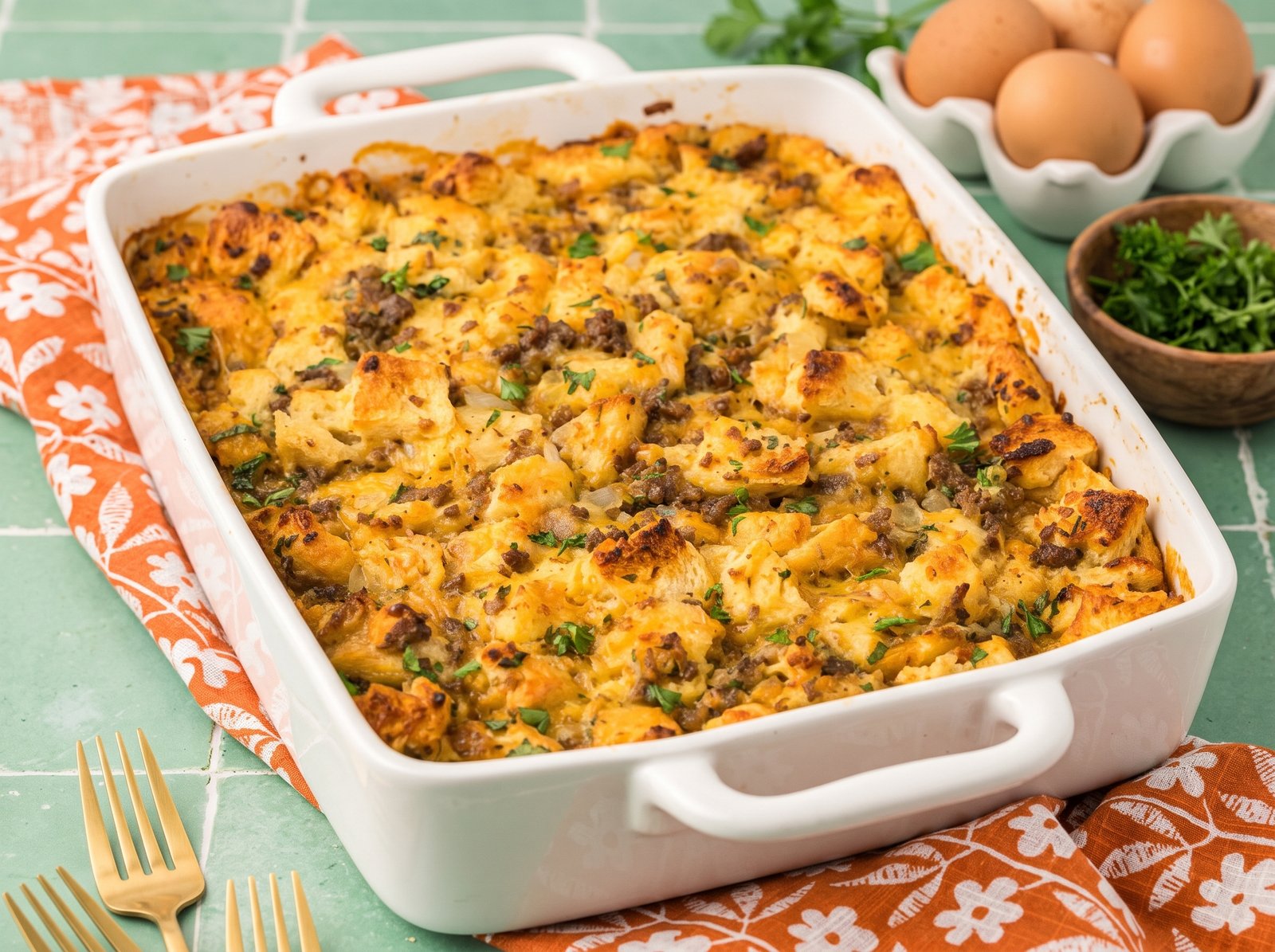
Overnight Sausage Breakfast Strata
Ingredients
Equipment
Method
- Butter a 9×13 dish and spread the bread cubes in it.
- Brown sausage with onion and pepper for 8 to 10 minutes, drain and cool 10 minutes.
- Scatter over the bread with 1 1/2 cups cheese.
- Whisk eggs, milk, mustards, salt, pepper and nutmeg; pour over. Press down, cover and refrigerate 8 to 24 hours.
- Rest at room temperature while heating the oven to 350F (175C).
- Top with remaining cheese. Bake 50 to 60 minutes until set and 160F (71C) in the center.
- Rest 10 minutes and top with chives.
Notes
Wishing you a slow, sleepy, cozy Christmas morning with a warm dish waiting in the oven. Happy cooking, friends. Chef Amber
Free email bonus
30-Minute Meals
Loved this recipe? Get my collection of fast, family-favorite dinners, plus new seasonal recipes straight to your inbox.