
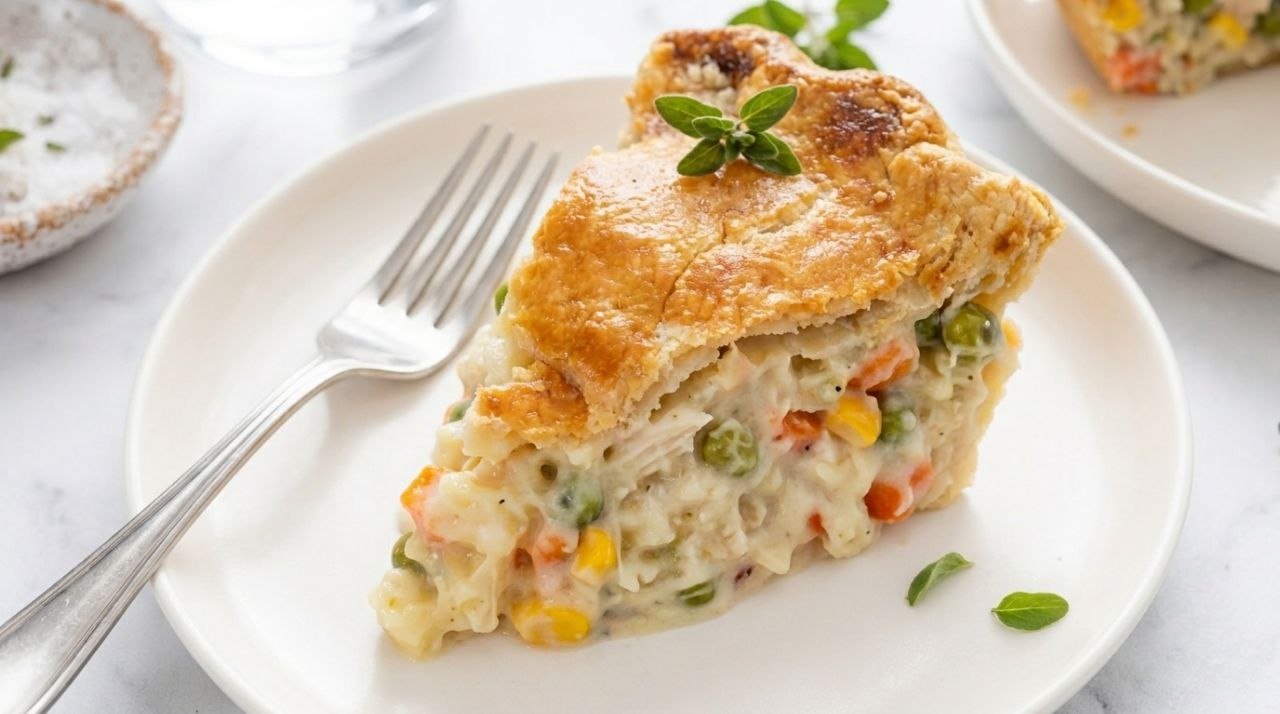
This homemade chicken pot pie has everything the classic version is supposed to have — a filling that is thick, creamy, and deeply savory with tender chicken and vegetables in every spoonful, and a crust that is genuinely flaky and golden and shatters when you press a fork through it rather than bending or pulling. It is built on a proper from-scratch roux-based sauce rather than canned soup, which gives the filling a clean, rich flavor that you cannot get from a shortcut, and it uses store-bought pie crust so the total prep time stays under twenty minutes. The result is a pot pie that tastes fully homemade because the filling is, and takes far less effort than the outcome would suggest because the crust is not.
What separates a good chicken pot pie from a great one is the filling-to-crust ratio and the consistency of the sauce. A filling that is too thin turns watery in the oven and pools at the bottom of the slice rather than holding together when cut. A filling that is too thick turns pasty and dense and makes the pie feel heavy rather than satisfying. This recipe builds the sauce in stages — roux first, then broth, then milk — which gives complete control over the final thickness before the filling ever goes into the crust. By the time it comes out of the oven, the filling is set to exactly the right consistency: thick enough to hold a clean slice, loose enough to spoon generously over the plate.
Why the Roux Is the Heart of This Recipe
The roux — butter and flour cooked together before any liquid is added — is the technical foundation that separates a properly made chicken pot pie filling from a loosely thickened soup poured into a crust. When butter melts and flour is stirred into it over heat, the starch granules in the flour coat with fat, which prevents them from clumping when liquid is added later and allows them to hydrate and swell evenly through the entire sauce as it cooks. A filling made with a proper roux thickens uniformly and smoothly; a filling thickened with a cornstarch slurry added directly to hot liquid can thicken unevenly, thin out again as the filling cools and reheats in the oven, and sometimes separate into a grainy texture at higher temperatures. The roux is not an extra step — it is the step that determines whether the filling holds together as a clean slice or collapses into a puddle the moment the crust is cut.
The Pastry Science Behind a Flaky Crust
The flakiness of a pie crust comes from the physical structure of the fat within the dough rather than from any chemical leavening agent. When cold butter is cut into flour — either by hand, pastry blender, or food processor — it breaks into flat, irregular pieces that are coated with flour on their surfaces but remain solid and distinct rather than melting into the dough. In the oven, those solid butter pieces melt rapidly, releasing steam and leaving thin, empty pockets in the dough where the butter used to be. Those pockets are the flakes: layers of cooked dough separated by air that creates the characteristic shatter when a fork or knife presses through a properly made crust.
This is why cold butter — and cold everything, including the water — is so critical in pastry making. Shortcrust pastry made with warm or softened butter produces a crust where the fat has already partially merged with the flour, creating a more uniform, tender-but-sandy texture rather than a layered, flaky one. Store-bought refrigerated pie crust is made using an industrial process that achieves the same structural goal — cold fat layered through cold dough — and produces genuinely flaky results with none of the technique or timing requirements of making it from scratch, which is why it is the right call for a recipe that already has a from-scratch filling.
What Goes In
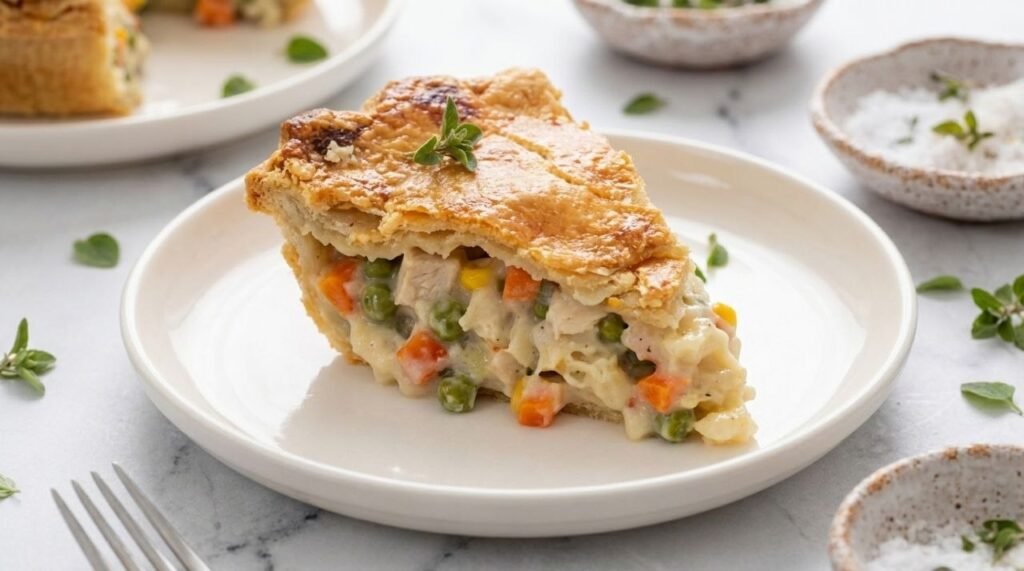
Classic ingredients, from-scratch filling, store-bought crust for a smart time save.
1 box refrigerated pie crusts (2 crusts), room temperature
2.5 cups cooked chicken, shredded or diced (rotisserie works perfectly)
2 cups frozen mixed vegetables (peas, carrots, corn, green beans)
1/3 cup unsalted butter
1/3 cup yellow onion, finely diced
1/3 cup all-purpose flour
1 3/4 cups low-sodium chicken broth
2/3 cup whole milk
1 teaspoon garlic powder
1/2 teaspoon dried thyme
1/2 teaspoon celery seed
1 teaspoon salt, plus more to taste
1/2 teaspoon black pepper
1 egg + 1 tablespoon milk, for egg wash
Variations Worth Trying
Use puff pastry for the top crust only — a single sheet of puff pastry laid over a pie dish of filling and baked at 400 degrees F gives a dramatically flakier, more dramatic top layer than regular pie crust, with visible pastry layers that separate and rise in the oven.
Substitute heavy cream for the milk in the filling for a richer, more indulgent sauce that is noticeably thicker and more restaurant-style in texture — the higher fat content keeps the sauce smooth and creamy even after the full oven bake without any risk of the milk proteins separating at high heat.
Add half a cup of sliced mushrooms to the onions in the first step and cook until softened before making the roux — the mushrooms add a savory, earthy depth to the filling that makes it taste more complex without requiring any additional seasoning changes.
Make individual pot pies in ramekins instead of a single large pie — divide the filling between 4 to 6 oven-safe ramekins, top each with a circle of pie crust cut to fit, and bake at 425 degrees F for 20 to 25 minutes. Individual pies look more intentional when plated and reheat more evenly than slices of a full pie.
How to Make Easy Homemade Chicken Pot Pie
Step 1 – Prep and preheat: Preheat your oven to 425 degrees F. Remove the refrigerated pie crusts from the refrigerator and allow them to sit at room temperature for 15 minutes — cold pie crust cracks when unrolled, and a slightly warmer crust unfolds cleanly without tearing. Press the first crust into the bottom of a 9-inch pie plate, letting the excess hang over the edge, and set it aside while you make the filling. If you are using rotisserie chicken, shred it now and measure 2.5 cups.
Step 2 – Build the roux base: In a medium saucepan over medium heat, melt the butter completely. Add the diced onion and cook for two to three minutes, stirring frequently, until the onion is translucent and soft but not browned. Add the flour all at once and stir constantly for one full minute — the mixture will look like a thick, golden paste. This one minute of cooking is important: it cooks out the raw flour taste that otherwise leaves the finished filling with a slightly starchy, flat note underneath the chicken and vegetable flavors.
Step 3 – Build the sauce: With the pan still over medium heat, gradually pour in the chicken broth, about a quarter cup at a time, whisking constantly after each addition until fully incorporated before adding more. Once all the broth is in, add the milk in a slow, steady stream while continuing to whisk. Add the garlic powder, dried thyme, celery seed, salt, and pepper. Continue cooking and stirring over medium heat for 3 to 4 minutes until the sauce thickens to a consistency that coats the back of a spoon and holds a line when you drag your finger through it.
Step 4 – Add the chicken and vegetables: Remove the saucepan from the heat. Stir in the shredded chicken and frozen mixed vegetables and fold everything together until evenly distributed through the sauce. Taste the filling and adjust salt and pepper — the filling should taste well-seasoned and slightly salty at this stage, since the crust will absorb some of that salt and the flavor will mellow slightly after baking. Pour the finished filling into the prepared bottom crust in the pie plate.
Step 5 – Top, seal, and bake: Lay the second pie crust over the filled pie. Press the edges of the top and bottom crusts together firmly with your fingers, then fold the excess under and crimp the edge with a fork or pinch it into a decorative fluted edge. Cut four to six one-inch slits in the top crust with a sharp knife to allow steam to vent during baking — without vents, steam from the hot filling has nowhere to escape and can cause the top crust to bubble up and separate from the filling. Beat the egg with one tablespoon of milk and brush it evenly over the entire top crust surface. Bake at 425 degrees F for 30 to 40 minutes, until the crust is deep golden brown. If the edges start browning too quickly before the center is done, cover them with strips of aluminum foil for the remaining bake time. Cool for 10 minutes before slicing.
3 Mistakes That Ruin Chicken Pot Pie
Making the filling too thin before it goes into the crust: The filling thickens in the oven as it heats, but it also releases moisture from the chicken and vegetables as they cook further, which thins the sauce slightly. A filling that looks perfectly saucy at the correct thickness on the stovetop will often be too loose in the finished pie. The sauce should look slightly thicker than your target consistency when it comes off the stove — thick enough to hold a spoon upright briefly before slowly sliding — so that after baking it lands at exactly the right spoonable, sliceable consistency.
Skipping the venting slits in the top crust: Steam generated by the hot filling during baking needs a path out of the pie. A sealed, unvented top crust traps that steam inside and causes it to collect and condense against the underside of the pastry, making the interior surface of the crust wet and doughy rather than dry and flaky. The slits take five seconds to cut and are the difference between a crust that is flaky all the way through and one that looks golden on the outside but is soft and slightly undercooked on the bottom side facing the filling.
Cutting into the pie immediately out of the oven: The filling inside a freshly baked pot pie is liquid and extremely hot — it has been simmering and bubbling under the crust for thirty to forty minutes and needs at least ten minutes of resting time to begin setting back into a cohesive, sliceable consistency. Cutting immediately causes the filling to pour out of the slice rather than holding its shape, which makes the pie impossible to plate cleanly and wastes the textural work the roux and oven time put in. Ten minutes of patience produces a slice that holds together; zero patience produces a bowl of chicken stew with crust on top.
What to Serve with Chicken Pot Pie
Chicken pot pie is a full meal in a crust — protein, vegetables, and pastry together — which means the best sides are light enough to complement without adding more heaviness to an already rich plate. A simple green salad with a sharp vinaigrette is the most natural pairing, where the acidity of the dressing cuts through the buttery filling and crust and refreshes the palate between bites. Steamed broccoli or roasted asparagus provides a similar function with a vegetable that is simple enough not to compete with the complex savory flavors of the filling. For a dessert that continues the comfort-food spirit of the meal without requiring any oven work if you have been baking all afternoon, our Strawberry Crunch Cheesecake Cups are fully no-bake and can be made the night before, or our 3-Ingredient Banana Oat Cookies are light and simple enough to follow a rich, hearty dinner without feeling like a second full course.

Easy Homemade Chicken Pot Pie
Ingredients
Equipment
Method
- How to Make Easy Homemade Chicken Pot Pie
- Step 1 – Prep and preheat: Preheat your oven to 425 degrees F. Remove the refrigerated pie crusts from the refrigerator and allow them to sit at room temperature for 15 minutes — cold pie crust cracks when unrolled, and a slightly warmer crust unfolds cleanly without tearing. Press the first crust into the bottom of a 9-inch pie plate, letting the excess hang over the edge, and set it aside while you make the filling. If you are using rotisserie chicken, shred it now and measure 2.5 cups.
- Step 2 – Build the roux base: In a medium saucepan over medium heat, melt the butter completely. Add the diced onion and cook for two to three minutes, stirring frequently, until the onion is translucent and soft but not browned. Add the flour all at once and stir constantly for one full minute — the mixture will look like a thick, golden paste. This one minute of cooking is important: it cooks out the raw flour taste that otherwise leaves the finished filling with a slightly starchy, flat note underneath the chicken and vegetable flavors.
- Step 3 – Build the sauce: With the pan still over medium heat, gradually pour in the chicken broth, about a quarter cup at a time, whisking constantly after each addition until fully incorporated before adding more. Once all the broth is in, add the milk in a slow, steady stream while continuing to whisk. Add the garlic powder, dried thyme, celery seed, salt, and pepper. Continue cooking and stirring over medium heat for 3 to 4 minutes until the sauce thickens to a consistency that coats the back of a spoon and holds a line when you drag your finger through it.
- Step 4 – Add the chicken and vegetables: Remove the saucepan from the heat. Stir in the shredded chicken and frozen mixed vegetables and fold everything together until evenly distributed through the sauce. Taste the filling and adjust salt and pepper — the filling should taste well-seasoned and slightly salty at this stage, since the crust will absorb some of that salt and the flavor will mellow slightly after baking. Pour the finished filling into the prepared bottom crust in the pie plate.
- Step 5 – Top, seal, and bake: Lay the second pie crust over the filled pie. Press the edges of the top and bottom crusts together firmly with your fingers, then fold the excess under and crimp the edge with a fork or pinch it into a decorative fluted edge. Cut four to six one-inch slits in the top crust with a sharp knife to allow steam to vent during baking — without vents, steam from the hot filling has nowhere to escape and can cause the top crust to bubble up and separate from the filling. Beat the egg with one tablespoon of milk and brush it evenly over the entire top crust surface. Bake at 425 degrees F for 30 to 40 minutes, until the crust is deep golden brown. If the edges start browning too quickly before the center is done, cover them with strips of aluminum foil for the remaining bake time. Cool for 10 minutes before slicing.
Notes
