
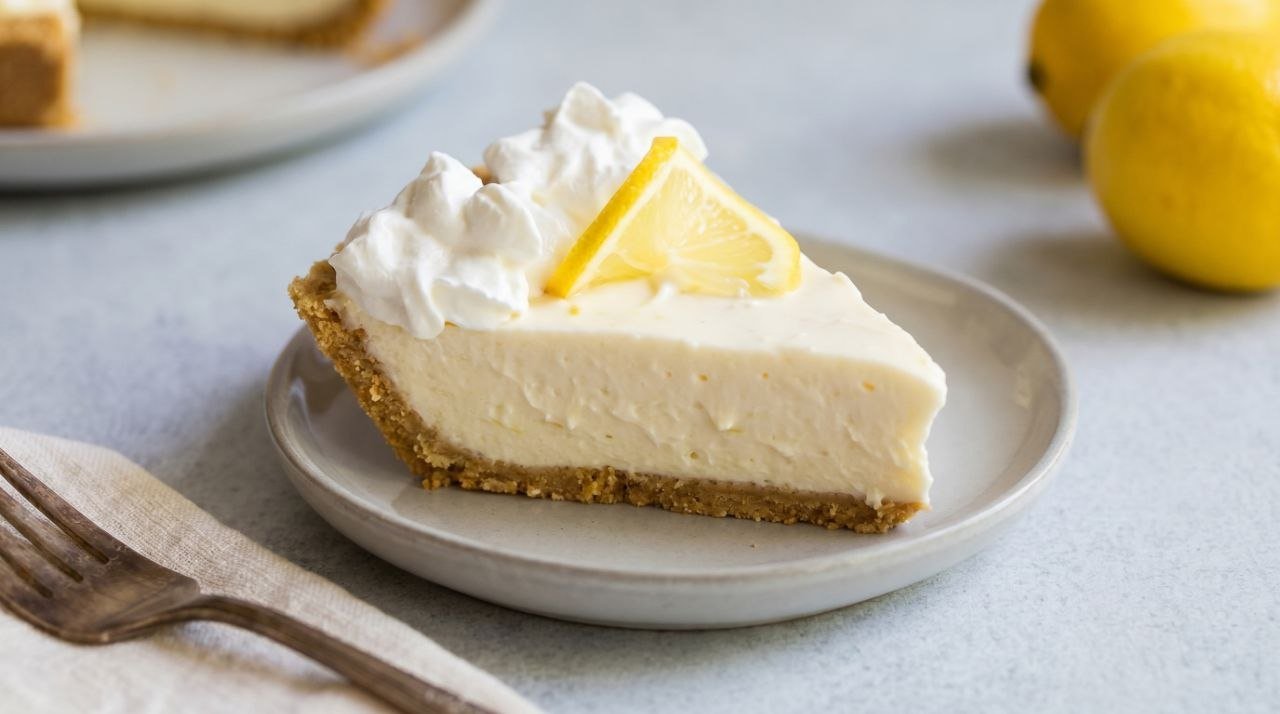
Lemon icebox pie is the Southern summer dessert that has been cooling down dining room tables since the 1930s — a buttery graham cracker crust filled with a silky, intensely lemony cream made from sweetened condensed milk, fresh lemon juice, and cream cheese, then chilled until firm enough to slice into clean, picture-perfect wedges that taste simultaneously like lemonade, cheesecake, and the most refreshing thing anyone has eaten all summer. No oven. No water bath. No cracking. The acid in the fresh lemon juice sets the condensed milk filling without any baking at all, producing a smooth, dense, sliceable cream that holds its shape on the plate and delivers a sharp, bright lemon flavor in every bite that no boxed pudding or artificial flavoring can come close to replicating. This is the pie that disappears first at every summer gathering, the one guests ask about, and the one that is secretly the easiest thing on the table.
The name “icebox” references the era before modern refrigerators when chilled desserts were set in an icebox — a wooden cabinet packed with blocks of ice — and the name has survived as a descriptor for any no-bake pie that requires refrigeration or freezing to set its filling. The lemon icebox pie is a close cousin of the Key lime pie, which uses the same acid-set condensed milk filling principle with lime juice instead of lemon — both pies rely on the same chemical reaction between citric acid and the casein proteins in sweetened condensed milk to produce a firm, creamy filling without heat. The lemon version is brighter and more sharply citrusy than the Key lime version, with a flavor that is immediately recognizable as lemon rather than the subtler, more floral character of lime, and it pairs more universally with a wider variety of garnishes — whipped cream, fresh berries, lemon curd swirls — because its flavor is more forthright and accommodating of accompaniment.
How Lemon Juice Sets the Filling Without Heat
The acid-set mechanism that transforms the liquid mixture of sweetened condensed milk and lemon juice into a firm, sliceable cream without any baking is one of the most elegant examples of food chemistry in everyday cooking. Fresh lemon juice is rich in citric acid — approximately 5 to 6 percent by weight — and when this acid contacts the casein proteins in sweetened condensed milk, it disrupts the electrical charges that keep those protein molecules dispersed and separated in the liquid. The proteins begin to partially aggregate into a loose network that traps the fat globules, water molecules, and sugar dissolved in the condensed milk within its structure, producing a gel-like consistency that sets firm at refrigerator temperature. Adding cream cheese to the filling accelerates and strengthens this setting effect by contributing additional fat and protein to the network — the result is a filling that is significantly firmer and more sliceable than lemon-condensed milk alone, with a richness and density that makes each slice hold its wedge shape cleanly on the plate rather than sagging or spreading.
Fresh Lemon vs. Bottled — Why It Matters Here
In a pie where lemon is the only flavor — where there is no chocolate, no vanilla, no spice to share the sensory load — the quality of the lemon juice is the quality of the pie. Fresh lemon juice contains hundreds of volatile aromatic compounds alongside its citric acid: limonene, linalool, citral, and geraniol among them, each contributing a specific aspect of the bright, floral, intensely citrusy character that makes fresh lemon juice taste alive and vibrant rather than simply sour. Heat pasteurization during the production of bottled lemon juice destroys the majority of these volatile aromatic compounds, leaving the citric acid content intact but stripping away nearly all of the aroma and complexity that make lemon juice taste like lemon rather than like generic tartness. In a filling that is nothing but lemon, sweetened condensed milk, and cream cheese, the difference between fresh and bottled juice is the difference between a pie that tastes unmistakably and compellingly of fresh lemon and a pie that tastes sweet and tart but unspecific — pleasant but not memorable, and certainly not worth the recipe request.
What Goes In

Five ingredients, one pie dish, zero oven — pure summer in every slice.
For the crust:
1.5 cups graham cracker crumbs (about 12 full sheets)
6 tablespoons unsalted butter, melted
2 tablespoons granulated sugar
For the lemon filling:
8 oz (1 block) full-fat cream cheese, softened to room temperature
1 (14 oz) can sweetened condensed milk
1/2 cup fresh lemon juice (approximately 3 to 4 lemons)
1 tablespoon fresh lemon zest
1 teaspoon pure vanilla extract
For topping:
1 cup heavy whipping cream, beaten to stiff peaks with 2 tablespoons powdered sugar
Fresh lemon slices and zest curls, for garnish
Variations Worth Trying
Swap half the lemon juice for fresh lime juice for a lemon-lime version with a more complex citrus profile that is slightly more floral and aromatic than pure lemon alone — the combination references the classic lemon-lime flavor pairing of citrus soda but in a sophisticated, creamy dessert format.
Swirl two tablespoons of store-bought lemon curd over the top of the filling before refrigerating — the curd sinks partially into the surface during chilling and creates a bright, intensely lemony swirl pattern visible in every slice that makes the pie look as impressive as it tastes.
Use a vanilla wafer crust instead of graham crackers — crush Nilla Wafers and mix with the same butter quantity for a sweeter, more vanilla-forward base that pairs with the lemon filling in a way that is slightly more dessert-forward than the neutral honey-wheat character of graham crackers.
Top each slice with fresh blueberries or raspberries immediately before serving — the color contrast of dark berries against the pale yellow filling is visually striking, and the slight tartness of the berries amplifies the lemon flavor of the filling in the same way a garnish of fresh fruit amplifies the primary flavor of any citrus dessert.
How to Make Lemon Icebox Pie
Step 1 – Make and chill the crust: Crush graham crackers into fine, uniform crumbs using a rolling pin in a zip-lock bag or a food processor. Combine with the melted butter and granulated sugar in a bowl and mix until every crumb is evenly moistened. Press the mixture firmly and evenly into the bottom and up the sides of a 9-inch pie dish using the flat bottom of a measuring cup — press particularly firmly at the point where the bottom meets the sides, as this junction is the most structurally important part of the crust and the area most likely to crumble when slices are removed. Freeze the crust for 15 minutes while you prepare the filling — the cold firms the butter and produces a crust that does not crumble when the filling is added.
Step 2 – Beat the cream cheese base: In a large mixing bowl, beat the room-temperature cream cheese with a hand mixer on medium speed for two minutes until completely smooth with no lumps — cold cream cheese will produce a lumpy filling that no subsequent step can correct, so ensure it is genuinely at room temperature before beginning. Add the sweetened condensed milk and beat on low speed for thirty seconds until just combined and smooth — do not over-beat at this stage as excessive mixing can make the condensed milk slightly grainy. Add the fresh lemon juice, lemon zest, and vanilla extract and beat on low for thirty additional seconds until fully incorporated. The filling will visibly thicken slightly as the lemon juice contacts the condensed milk — this is the acid-set reaction beginning immediately.
Step 3 – Fill and refrigerate: Remove the chilled crust from the freezer. Pour the lemon filling into the crust and spread evenly to the edges with an offset spatula, smoothing the surface completely flat. Cover the pie loosely with plastic wrap — do not press the wrap to the filling surface as it will leave an impression — and refrigerate for a minimum of four hours. Overnight refrigeration produces the firmest, cleanest-slicing result and is strongly recommended. The filling will set from a pourable liquid into a firm, dense cream during this refrigeration period.
Step 4 – Make the whipped cream topping: When ready to serve, beat the cold heavy whipping cream with the powdered sugar using a hand mixer on medium-high speed until stiff peaks form — approximately three to four minutes. The whipped cream should hold a firm peak when the beaters are lifted and not slump or flow. Either spread the whipped cream over the entire surface of the pie in a thick, swirled layer, or transfer to a piping bag fitted with a star tip and pipe decorative rosettes or a border around the edge of the pie — both approaches look beautiful, with the piped border allowing the pale yellow lemon filling to remain visible in the center for visual contrast.
Step 5 – Garnish and serve: Arrange thin lemon slices — cut to the center and twisted into S-curves — across the surface of the pie along with a scatter of fresh lemon zest curls made by dragging a vegetable peeler along the length of a lemon. Serve immediately after decorating — the whipped cream topping holds its shape for approximately two hours at refrigerator temperature before beginning to weep, so add the topping and garnish as close to serving time as possible. Cut with a sharp knife run under hot water and wiped dry between each cut for the cleanest, most defined slices.
3 Mistakes That Ruin Lemon Icebox Pie
Using bottled lemon juice: As described above, bottled lemon juice is pasteurized at temperatures that destroy the volatile aromatic compounds responsible for the bright, complex, genuinely lemony character that makes this pie worth making. In a filling with no other flavoring ingredients, this substitution produces a pie that is adequately sweet and tart but tastes of preserved, slightly flat citrus rather than fresh, vibrant lemon. The cost difference between bottled lemon juice and fresh lemons for this recipe is a few dollars — the quality difference in the finished pie is everything, and every person who has made both versions agrees that fresh is the only acceptable choice for lemon icebox pie.
Not chilling the filling long enough before slicing: The acid-set mechanism that firms this filling is a gradual process that requires sustained cold temperature to complete — at four hours of refrigeration, the filling is set but still slightly soft at the center; at eight hours or overnight, it is uniformly firm throughout the depth of the pie and produces clean, cohesive slices with a defined edge that holds its shape on the plate. A pie sliced at two hours has a partially set filling that is firm at the edges but soft and yielding at the center, producing slices that collapse and lose their shape as soon as they are plated. Patience at the refrigeration stage is the entire difference between a pie that looks impressive and one that looks like a mess of cream on a plate.
Over-beating the filling after the lemon juice is added: The acid-set thickening of the condensed milk-cream cheese mixture begins the moment the lemon juice contacts it, and excessive beating after this point incorporates air bubbles into the filling that create a slightly foam-like rather than dense and creamy texture in the finished slice. Beat only until the lemon juice is just incorporated — thirty seconds on low speed is sufficient — and pour immediately into the crust. The filling at this stage should look slightly thickened and pourable rather than whipped and airy, and it will continue to thicken and firm during the refrigeration period without any additional mixing.
What to Serve with Lemon Icebox Pie
Lemon icebox pie is the perfect finale to any summer meal because its cold, bright, citrusy character provides complete contrast to almost any savory main course — it refreshes the palate and ends the meal on a note that feels light and clean rather than heavy. A glass of iced sweet tea alongside is the quintessential Southern pairing — the mild tannins and sweetness of the tea balance the sharp lemon and cream of the pie in the same way tea pairs with lemon in every other context. For a summer dessert spread, pair this pie alongside our Frozen Strawberry Lemonade Pie for a side-by-side citrus comparison that lets guests choose between the two, and our No Bake Nutella Cheesecake Cups for those who prefer a rich chocolate option — three no-bake desserts, all made the day before, covering every preference at the summer table.

Easy Lemon Icebox Pie
Ingredients
Equipment
Method
- How to Make Lemon Icebox Pie
- Step 1 – Make and chill the crust: Crush graham crackers into fine, uniform crumbs using a rolling pin in a zip-lock bag or a food processor. Combine with the melted butter and granulated sugar in a bowl and mix until every crumb is evenly moistened. Press the mixture firmly and evenly into the bottom and up the sides of a 9-inch pie dish using the flat bottom of a measuring cup — press particularly firmly at the point where the bottom meets the sides, as this junction is the most structurally important part of the crust and the area most likely to crumble when slices are removed. Freeze the crust for 15 minutes while you prepare the filling — the cold firms the butter and produces a crust that does not crumble when the filling is added.
- Step 2 – Beat the cream cheese base: In a large mixing bowl, beat the room-temperature cream cheese with a hand mixer on medium speed for two minutes until completely smooth with no lumps — cold cream cheese will produce a lumpy filling that no subsequent step can correct, so ensure it is genuinely at room temperature before beginning. Add the sweetened condensed milk and beat on low speed for thirty seconds until just combined and smooth — do not over-beat at this stage as excessive mixing can make the condensed milk slightly grainy. Add the fresh lemon juice, lemon zest, and vanilla extract and beat on low for thirty additional seconds until fully incorporated. The filling will visibly thicken slightly as the lemon juice contacts the condensed milk — this is the acid-set reaction beginning immediately.
- Step 3 – Fill and refrigerate: Remove the chilled crust from the freezer. Pour the lemon filling into the crust and spread evenly to the edges with an offset spatula, smoothing the surface completely flat. Cover the pie loosely with plastic wrap — do not press the wrap to the filling surface as it will leave an impression — and refrigerate for a minimum of four hours. Overnight refrigeration produces the firmest, cleanest-slicing result and is strongly recommended. The filling will set from a pourable liquid into a firm, dense cream during this refrigeration period.
- Step 4 – Make the whipped cream topping: When ready to serve, beat the cold heavy whipping cream with the powdered sugar using a hand mixer on medium-high speed until stiff peaks form — approximately three to four minutes. The whipped cream should hold a firm peak when the beaters are lifted and not slump or flow. Either spread the whipped cream over the entire surface of the pie in a thick, swirled layer, or transfer to a piping bag fitted with a star tip and pipe decorative rosettes or a border around the edge of the pie — both approaches look beautiful, with the piped border allowing the pale yellow lemon filling to remain visible in the center for visual contrast.
- Step 5 – Garnish and serve: Arrange thin lemon slices — cut to the center and twisted into S-curves — across the surface of the pie along with a scatter of fresh lemon zest curls made by dragging a vegetable peeler along the length of a lemon. Serve immediately after decorating — the whipped cream topping holds its shape for approximately two hours at refrigerator temperature before beginning to weep, so add the topping and garnish as close to serving time as possible. Cut with a sharp knife run under hot water and wiped dry between each cut for the cleanest, most defined slices
Notes
