
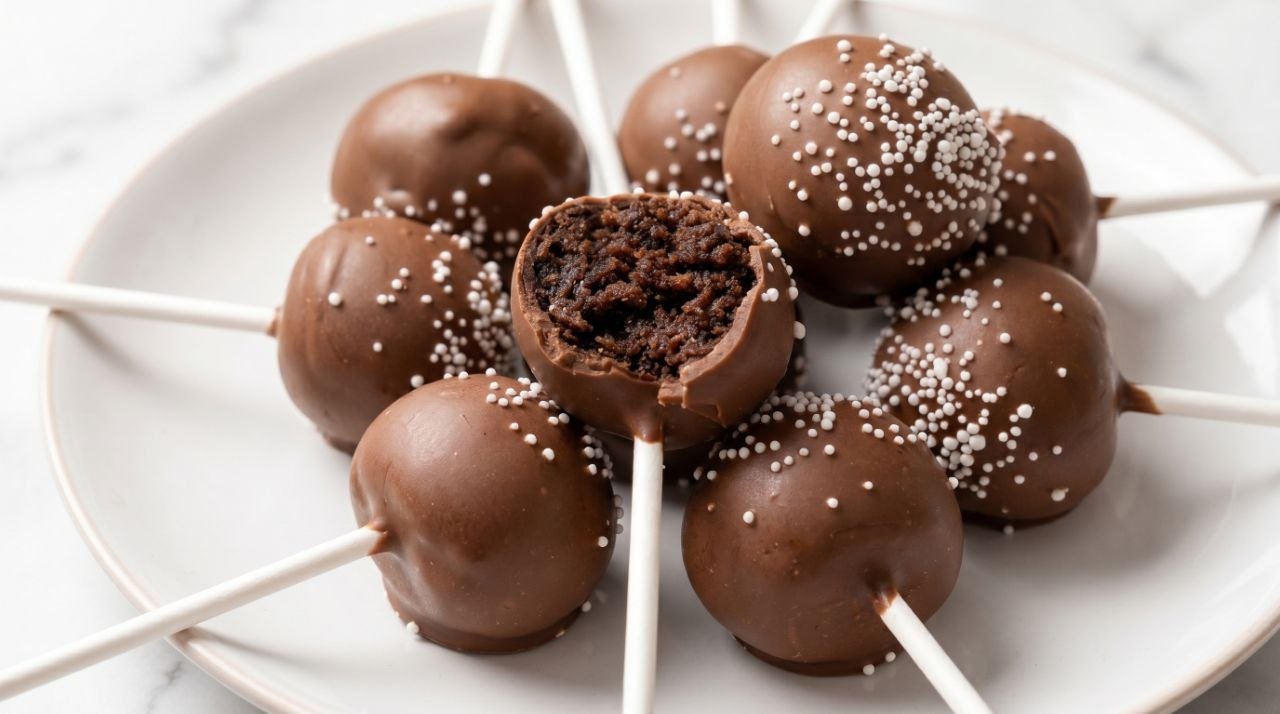
These copycat Starbucks chocolate cake pops taste better than the original, cost a fraction of the price, and make approximately thirty pops from four simple ingredients — a box of chocolate cake mix, two tablespoons of chocolate frosting, a bag of dark chocolate candy melts, and white sprinkles. That is the entire recipe. The cake bakes, crumbles, binds with frosting into a dense, fudgy dough, gets rolled into balls, dipped in melted chocolate, and finished with a scatter of white sprinkles that is the unmistakable visual signature of the Starbucks version. The process takes about an hour from start to finish, produces a batch large enough for a party, a bake sale, or a week of individually wrapped treats, and saves approximately three dollars per cake pop compared to the Starbucks counter price.
What makes a cake pop work as a format — what distinguishes it from simply a ball of cake on a stick — is the binding ratio between crumbled cake and frosting, and the temperature management of the cake ball before it goes into the chocolate coating. The cake provides structure and flavor; the frosting provides the fat and moisture that binds the dry crumbs into a dough that holds its shape under rolling without being so wet that it falls apart in the coating. Too much frosting and the interior is too soft and dense; too little and the ball cracks apart when the stick is inserted. Two tablespoons of frosting per box of chocolate cake is the precise ratio that produces the dense, fudgy, exactly-like-Starbucks interior texture that no amount of experimentation with higher frosting quantities will improve.
The Science Behind the Perfect Cake Pop Coating
The smooth, crack-free chocolate shell that defines a well-made cake pop is the result of chocolate tempering — the process by which chocolate’s cocoa butter crystals are organized into a stable crystalline form that sets glossy, hard, and smooth rather than dull, soft, or streaky. Candy melts are specifically engineered to skip the traditional tempering process because they contain vegetable fat instead of pure cocoa butter — vegetable fats set at a more predictable and forgiving temperature range than cocoa butter, which is why candy melts produce a consistently smooth, shiny shell when melted and cooled without the precise temperature control that real chocolate tempering requires. Adding a teaspoon of flavorless coconut oil or vegetable shortening to the melted candy melts thins the coating slightly, which produces a thinner shell per dip and allows excess coating to drip off the ball cleanly rather than pooling at the stick base into an uneven, thick-bottomed shell.
Why the Cake Ball Temperature is Everything
A cake ball that is too warm when dipped into the chocolate coating causes the coating to melt rather than set on contact, producing a runny, uneven shell that slides off the ball before it can firm up. A cake ball that is too frozen — taken directly from the freezer and dipped immediately — causes the warm chocolate coating to contract rapidly as it contacts the cold ball, which creates a temperature differential that cracks the chocolate shell as both the coating and the ball reach equilibrium temperature. The correct temperature for dipping is achieved by freezing the balls for fifteen to twenty minutes until firm and cold, then allowing them to rest at room temperature for two to three minutes before dipping — cold enough that the coating sets within thirty to forty-five seconds of contact, but not so frozen that the rapid temperature change shatters the shell. This narrow temperature window is the single most technically precise step in cake pop making, and understanding why it matters makes it much easier to manage consistently.
What Goes In
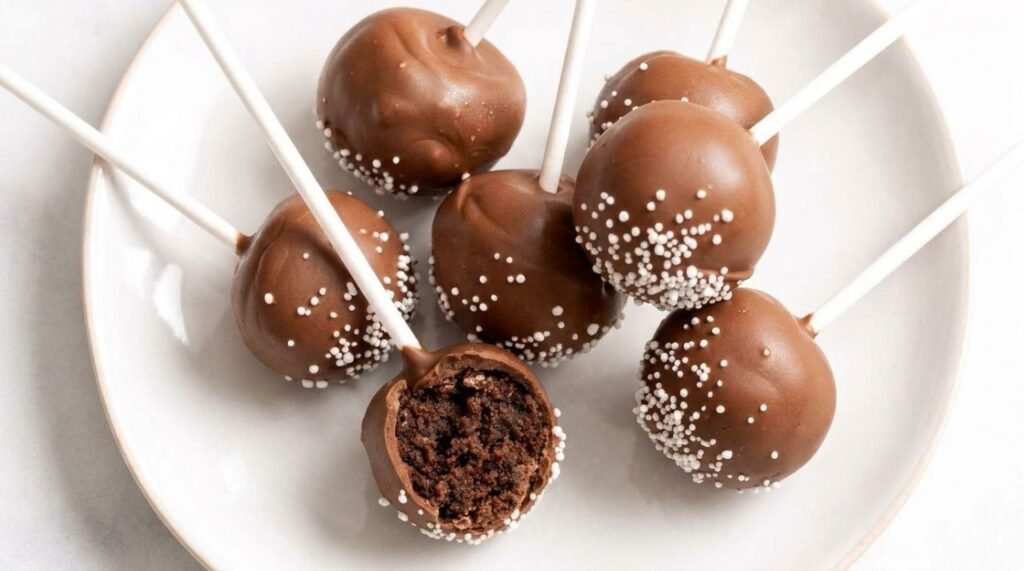
Four ingredients, one batch, thirty cake pops.
1 box chocolate cake mix (plus eggs, oil, and water as directed on the box)
2 tablespoons store-bought chocolate frosting
1 (12 oz) bag dark chocolate candy melts
1 teaspoon coconut oil or flavorless vegetable shortening
White nonpareil sprinkles, for finishing
30 lollipop sticks
Styrofoam block or cake pop stand, for drying
Variations Worth Trying
Use white candy melts instead of dark chocolate for a birthday cake pop version — swap the chocolate cake mix for vanilla, use vanilla frosting as the binder, and coat in pink candy melts with white sprinkles for a near-perfect replica of the Starbucks Birthday Cake Pop that is visually iconic and universally beloved at children’s parties.
Drizzle a contrasting color of melted candy melt over the set chocolate coating using a fork or squeeze bottle — white drizzle over dark chocolate or dark chocolate drizzle over pink coating adds a professional decorative detail that takes thirty additional seconds per pop and makes the finished batch look significantly more intentional and polished.
Add a teaspoon of espresso powder to the chocolate cake batter before baking for a mocha cake pop — espresso intensifies chocolate flavor without making the finished pop taste like coffee, and the combination of dark chocolate coating and mocha interior produces a version that tastes more complex and sophisticated than the plain chocolate original.
Mix two tablespoons of peanut butter into the crumbled cake along with the frosting binder for a chocolate peanut butter cake pop version — reduce the frosting slightly to two teaspoons since the peanut butter provides additional binding fat, and coat in milk chocolate candy melts for a Reese’s-inspired flavor combination.
How to Make Copycat Starbucks Chocolate Cake Pops
Step 1 – Bake and cool the cake: Prepare and bake the chocolate cake mix according to the package directions in a 9×13 inch baking pan. Allow the cake to cool completely at room temperature — do not attempt to work with warm cake. A warm cake crumbles too loosely and produces cake balls that are soft, sticky, and impossible to roll smoothly. Full cooling takes approximately one hour at room temperature or thirty minutes if the pan is placed on a wire rack. The cake can be baked the night before and left covered at room temperature overnight, which makes the day-of assembly entirely hands-on work without any waiting.
Step 2 – Crumble and bind: Remove the cooled cake from the pan and break it into chunks directly into a large mixing bowl. Using your hands or a fork, crumble the cake into fine, uniform crumbs with no large lumps remaining — the finer and more uniform the crumbs, the smoother and more cohesive the finished ball surface will be. Add exactly two tablespoons of chocolate frosting to the crumbled cake and mix thoroughly with a fork or your hands until the mixture holds together when pressed firmly between your fingers and can be formed into a ball that maintains its shape without cracking. Resist adding more frosting — two tablespoons is the correct amount for this texture, and adding more produces a ball that is too soft to dip cleanly.
Step 3 – Roll and freeze the balls: Using a 1.5-tablespoon cookie scoop or your hands, portion the cake mixture into equal pieces and roll each between your palms into a smooth, firm ball. Place the finished balls on a parchment-lined baking sheet with space between each ball. Slide the baking sheet into the freezer and freeze for 15 to 20 minutes until the balls are cold and firm throughout — they should feel solid when gently squeezed, not soft or yielding. Do not freeze longer than 30 minutes or the balls will be too frozen for the dipping step.
Step 4 – Attach the sticks: Melt approximately a quarter cup of the candy melts in a microwave-safe bowl in 30-second intervals, stirring between each, until completely smooth. Remove the cake balls from the freezer. Dip the tip of each lollipop stick approximately half an inch into the melted chocolate, then insert the coated tip directly into the center of a cake ball, pushing it in approximately halfway through the ball. The melted chocolate on the stick tip acts as an adhesive that bonds the stick to the interior cake as it sets — a stick inserted into the ball without this chocolate dip will slide out when the finished cake pop is handled. Return the balls with their sticks to the freezer for five minutes to set the chocolate anchor.
Step 5 – Dip and decorate: Melt the remaining candy melts with the teaspoon of coconut oil in a deep, narrow glass in 30-second microwave intervals, stirring between each, until completely smooth and fluid. Remove the cake balls from the freezer and allow them to rest at room temperature for two minutes. Working quickly with three to four pops at a time, hold each pop by the stick and dip it straight down into the melted chocolate until fully submerged, then lift it straight up and gently tap your wrist — not the stick — to shake off the excess coating. Immediately scatter white nonpareil sprinkles over the wet coating before it sets. Insert the finished stick into the styrofoam block or cake pop stand and allow to set completely at room temperature for fifteen to twenty minutes until the coating is fully hardened and no longer tacky to the touch.
3 Mistakes That Ruin Cake Pops
Adding too much frosting to the cake crumbles: More frosting feels like it should produce a moister, better-tasting pop — but in the cake pop format, excess frosting produces a ball that is too soft and sticky to roll smoothly, too pliable to hold a clean spherical shape, and too warm-temperature-sensitive to dip without collapsing off the stick. The correct binding amount is the minimum needed to make the crumbles hold together under firm hand pressure — two tablespoons per box of cake mix. If the mixture still feels too dry and crumbly after mixing, add frosting one teaspoon at a time and test after each addition rather than adding a large amount at once.
Dipping into coating that is too thick: Candy melts that have not been thinned with a small amount of oil, or that have cooled and thickened during the dipping process, produce a coating that is too viscous to flow off the ball cleanly after dipping. The excess coating collects at the base of the ball around the stick entry point and hardens into an uneven, pooled ring that is the most visually obvious indicator of improperly thinned coating. Add coconut oil or shortening at the start and reheat the coating in 15-second microwave intervals whenever it begins to thicken during the batch — the coating temperature drops steadily as cold cake balls are dipped into it, and periodic reheating keeps it at the fluid consistency needed for a thin, even shell.
Swirling the pop to remove excess coating: The instinctive motion when trying to remove excess chocolate from a dipped cake pop is to swirl or rotate it — but swirling puts rotational stress on the stick-to-ball connection and is the primary cause of cake balls spinning off their sticks mid-dip and sinking into the coating bowl. The correct technique is to tap the wrist of the hand holding the stick firmly and repeatedly — each tap creates a downward jolt that shakes the excess coating off the ball through gravity without creating the rotational force that loosens the stick. It looks awkward compared to a graceful swirl but it is the technique used by every professional cake pop baker for exactly this reason.
What to Serve with Chocolate Cake Pops
Cake pops are individually portioned by design, which makes them the most naturally versatile dessert format for any gathering where people are standing, moving, or serving themselves without plates. At a birthday party dessert table they work best as part of a mixed spread alongside our Vanilla Pudding Dirt Cups for the children and our No Bake Banana Pudding Cheesecake as the centerpiece for adults — three different formats, three completely different flavor profiles, all made the day before, all individually served or easily sliced without a caterer. For a Starbucks-inspired at-home coffee setup, arrange the finished cake pops in a small vase or cake pop stand alongside cups of hot coffee and let guests pair them the way they would at the actual counter, at about one-tenth the cost per pop.

Easy Copycat Starbucks Chocolate Cake Pops
Ingredients
Equipment
Method
- How to Make Copycat Starbucks Chocolate Cake Pops
- Step 1 – Bake and cool the cake: Prepare and bake the chocolate cake mix according to the package directions in a 9×13 inch baking pan. Allow the cake to cool completely at room temperature — do not attempt to work with warm cake. A warm cake crumbles too loosely and produces cake balls that are soft, sticky, and impossible to roll smoothly. Full cooling takes approximately one hour at room temperature or thirty minutes if the pan is placed on a wire rack. The cake can be baked the night before and left covered at room temperature overnight, which makes the day-of assembly entirely hands-on work without any waiting.
- Step 2 – Crumble and bind: Remove the cooled cake from the pan and break it into chunks directly into a large mixing bowl. Using your hands or a fork, crumble the cake into fine, uniform crumbs with no large lumps remaining — the finer and more uniform the crumbs, the smoother and more cohesive the finished ball surface will be. Add exactly two tablespoons of chocolate frosting to the crumbled cake and mix thoroughly with a fork or your hands until the mixture holds together when pressed firmly between your fingers and can be formed into a ball that maintains its shape without cracking. Resist adding more frosting — two tablespoons is the correct amount for this texture, and adding more produces a ball that is too soft to dip cleanly.
- Step 3 – Roll and freeze the balls: Using a 1.5-tablespoon cookie scoop or your hands, portion the cake mixture into equal pieces and roll each between your palms into a smooth, firm ball. Place the finished balls on a parchment-lined baking sheet with space between each ball. Slide the baking sheet into the freezer and freeze for 15 to 20 minutes until the balls are cold and firm throughout — they should feel solid when gently squeezed, not soft or yielding. Do not freeze longer than 30 minutes or the balls will be too frozen for the dipping step.
- Step 4 – Attach the sticks: Melt approximately a quarter cup of the candy melts in a microwave-safe bowl in 30-second intervals, stirring between each, until completely smooth. Remove the cake balls from the freezer. Dip the tip of each lollipop stick approximately half an inch into the melted chocolate, then insert the coated tip directly into the center of a cake ball, pushing it in approximately halfway through the ball. The melted chocolate on the stick tip acts as an adhesive that bonds the stick to the interior cake as it sets — a stick inserted into the ball without this chocolate dip will slide out when the finished cake pop is handled. Return the balls with their sticks to the freezer for five minutes to set the chocolate anchor.
- Step 5 – Dip and decorate: Melt the remaining candy melts with the teaspoon of coconut oil in a deep, narrow glass in 30-second microwave intervals, stirring between each, until completely smooth and fluid. Remove the cake balls from the freezer and allow them to rest at room temperature for two minutes. Working quickly with three to four pops at a time, hold each pop by the stick and dip it straight down into the melted chocolate until fully submerged, then lift it straight up and gently tap your wrist — not the stick — to shake off the excess coating. Immediately scatter white nonpareil sprinkles over the wet coating before it sets. Insert the finished stick into the styrofoam block or cake pop stand and allow to set completely at room temperature for fifteen to twenty minutes until the coating is fully hardened and no longer tacky to the touch.
Notes
