
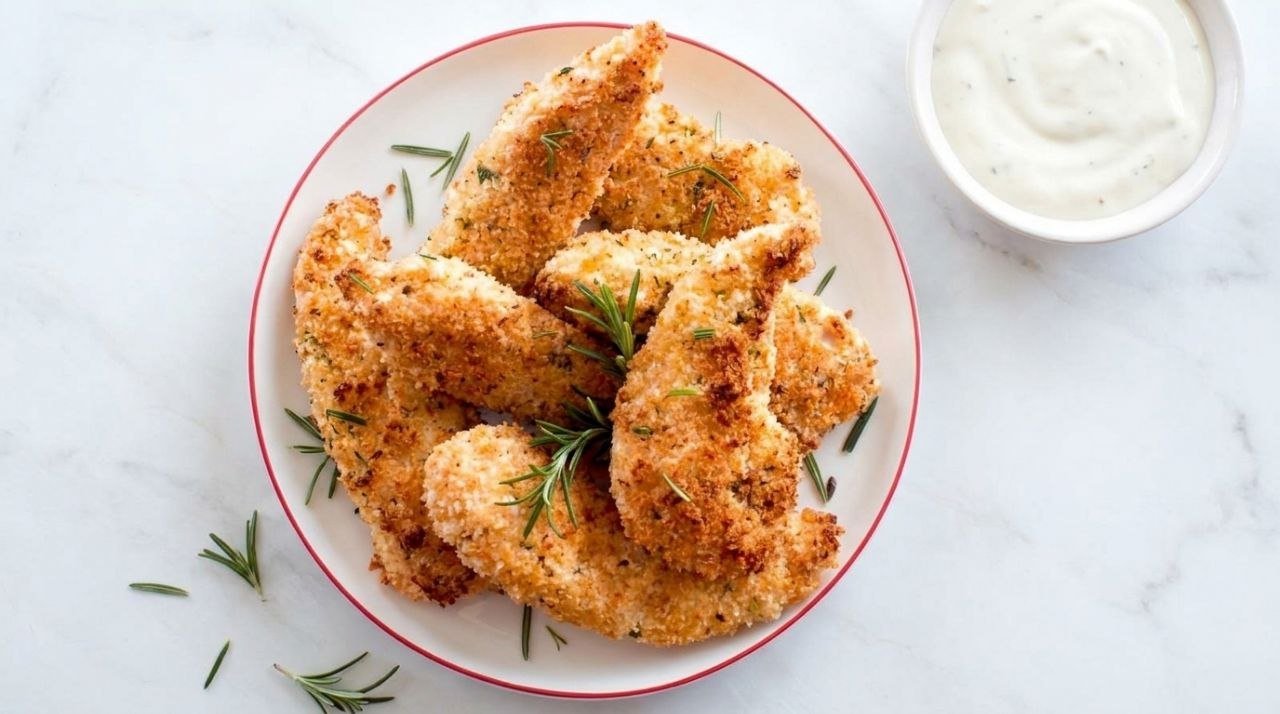
These crispy baked parmesan chicken tenders come out of the oven with a golden, shattering crust and juicy, tender meat inside — no deep fryer, no oil-splattered stovetop, and no paper towels full of absorbed grease. The secret is a three-component breading system: a thin flour base that gives the egg something to grip, an egg wash that binds the coating to the chicken, and a mixture of panko breadcrumbs and finely grated parmesan that bakes into a crust that is simultaneously crunchy, nutty, and deeply savory in a way that plain breadcrumbs alone never achieve. From preheating the oven to pulling the pan out takes exactly twenty-five minutes, and the result satisfies the craving for fried chicken with a fraction of the effort, the mess, and the oil.
What makes these tenders genuinely family-friendly beyond the obvious appeal of crispy chicken is that they work as a meal component in almost any direction the evening takes. Serve them with honey mustard and fries for a classic dinner. Slice them over a Caesar salad for a lunch that feels restaurant-worthy. Tuck them into a wrap with shredded lettuce and ranch dressing for something the kids will eat without negotiation. The parmesan crust holds up to all of these applications better than a plain breadcrumb coating because the fat and protein in the parmesan form a more rigid, cohesive crust that does not flake off or go soggy within minutes of leaving the oven the way lighter coatings tend to.
Why Panko and Parmesan Beat Regular Breadcrumbs
The combination of panko and parmesan in this recipe produces a crust that regular seasoned breadcrumbs simply cannot replicate in a baked application. Panko breadcrumbs are made from white bread with the crusts removed, processed into large, airy, irregular flakes rather than the fine, uniform crumbs of standard breadcrumbs. Those large flakes create more surface area exposure to the oven heat, which means more of the breading surface undergoes browning simultaneously — producing a crust that is dramatically crunchier and more golden than a fine-crumb coating that lies flatter against the chicken. The parmesan mixed into the panko contributes a second mechanism for crispiness: as the cheese heats in the oven, its fat renders out and its proteins set into a rigid matrix that holds the panko flakes together in a cohesive, hard crust rather than a loose, crumbly coating that falls off when handled.
The Wire Rack Trick for Maximum Crunch
Baking chicken tenders directly on a sheet pan produces a bottom crust that is soft, pale, and slightly soggy because the underside of the tender sits in direct contact with the metal pan surface and steams in the moisture that the chicken releases as it cooks. Elevating the breaded tenders on a wire rack set over the sheet pan allows hot oven air to circulate completely around every surface of the tender simultaneously — top, sides, and bottom — so the crust browns and crisps uniformly on all sides rather than developing a hard, golden top and a soft, pale underside. The moisture released from the chicken falls through the rack and away from the tenders rather than collecting beneath them, which eliminates the primary source of sogginess in oven-baked breaded chicken. This single equipment change produces a baked tender with the all-around crunch of a fried one.
What Goes In

Simple pantry ingredients, one sheet pan, twenty-five minutes.
1.5 lbs chicken tenderloins (or chicken breast sliced into 1-inch strips)
1/3 cup all-purpose flour
2 large eggs
1 tablespoon whole milk
1 cup panko breadcrumbs
2/3 cup finely grated parmesan cheese
1 teaspoon garlic powder
1 teaspoon Italian seasoning
1/2 teaspoon smoked paprika
1 teaspoon salt, divided
1/2 teaspoon black pepper
Olive oil spray
Honey mustard, ranch, or marinara for dipping
Variations Worth Trying
Add a teaspoon of lemon zest to the panko and parmesan mixture for a bright, citrusy note in the crust that pairs particularly well with a simple lemon aioli dipping sauce — the lemon flavor bakes into the crust and is present in every bite without needing any additional sauce.
Add a quarter teaspoon of cayenne pepper to the breadcrumb mixture for a spicy parmesan version that delivers a slow, building heat through the crust that kids can avoid and adults can seek out at the same meal simply by choosing their own dipping sauce.
Mix two tablespoons of finely chopped fresh rosemary or thyme into the panko and parmesan for an herbed version that works particularly well served alongside roasted vegetables or as a topping for a Caesar salad rather than as a standalone finger food.
Use the same breading on boneless chicken thighs cut into strips instead of tenderloins for a juicier, more forgiving version with more flavor — thigh meat has more fat and stays moister through the oven bake, making it more tolerant of slight overcooking than breast meat or tenderloins.
How to Make Crispy Baked Parmesan Chicken Tenders
Step 1 – Set up the breading station: Preheat your oven to 425 degrees F. Set a wire rack over a rimmed baking sheet and spray the rack with olive oil spray. Toast the panko in a dry skillet over medium heat for 2 to 3 minutes until light golden, then transfer to a shallow bowl and let cool for 2 minutes. Set out three shallow bowls in a line: Bowl 1 — flour with half the salt and half the pepper mixed in. Bowl 2 — eggs whisked with the tablespoon of milk until fully combined. Bowl 3 — toasted panko mixed with the parmesan, garlic powder, Italian seasoning, smoked paprika, and the remaining salt and pepper.
Step 2 – Prep the chicken: Pat the chicken tenderloins completely dry with paper towels on both sides — this is the most important step for coating adhesion. Any surface moisture on the chicken prevents the flour from sticking properly, which means the egg wash has nothing to cling to, which means the breadcrumb crust falls off in the oven rather than baking into a unified coating. If using chicken breast, slice it into strips approximately one inch wide and three to four inches long, cutting against the grain of the muscle fibers for maximum tenderness.
Step 3 – Bread each tender: Working one piece at a time, dredge the chicken tender in the flour bowl and shake off all excess — you want a thin, even film of flour on every surface with no thick clumps. Dip immediately into the egg wash, letting the excess drip back into the bowl for two seconds. Transfer to the panko and parmesan bowl and press firmly on all sides, rotating the tender and pressing the coating into the surface with your fingers to ensure maximum adherence. Place on the wire rack without the pieces touching.
Step 4 – Spray and bake: Spray the tops of all the breaded tenders generously with olive oil spray — this is the step that drives the golden browning on the surface of the crust. The oil facilitates the Maillard reaction on the breadcrumb surface by providing the fat needed for surface browning at the oven’s temperature, and without it the crust can bake to a dry, pale tan rather than a deep golden color. Bake at 425 degrees F for 14 to 16 minutes, flipping the tenders once at the 8-minute mark, until the crust is deep golden brown on both sides and an instant-read thermometer inserted into the thickest tender reads 165 degrees F.
Step 5 – Rest briefly and serve: Remove from the oven and rest for 3 minutes on the rack before serving — the crust needs a brief rest to fully set and crisp as the surface moisture finishes evaporating. Serve immediately with dipping sauces. These tenders are at their best within ten minutes of coming out of the oven, when the crust is at maximum crunch. If holding for longer, keep them on the wire rack in a 200-degree F oven uncovered — covering them or stacking them traps steam and softens the crust rapidly.
3 Mistakes That Ruin Baked Chicken Tenders
Skipping the flour layer: The flour step seems unnecessary — it is one extra bowl and one extra step — but it is structurally essential. The chicken surface is naturally moist and slightly smooth, and egg wash applied directly to a flourless chicken surface slides off rather than forming a continuous, even film. The thin flour coating creates a dry, slightly rough surface that the egg wash grips completely, which in turn allows the panko and parmesan to adhere firmly and evenly across the entire surface. A tender breaded without the flour step will have patchy coating with thin spots and bare patches where the crust pulled away from the smooth chicken surface during baking.
Baking directly on the sheet pan without a rack: The underside of a tender baked flat on a sheet pan sits in a puddle of the chicken’s own moisture from the moment it hits the hot metal, and that moisture steams the bottom coating rather than crisping it. The result is a tender with a beautifully golden top and a pale, soft, slightly damp bottom that gives way immediately when bitten rather than providing the all-around crunch that makes a properly baked tender satisfying. If you do not have a wire rack, bake on a sheet of parchment paper and flip the tenders at the halfway mark, which at least exposes the underside to direct oven heat for the second half of the bake time.
Overcrowding the pan: Chicken tenders placed touching or overlapping on the rack prevent the hot oven air from circulating to all surfaces equally, and the trapped moisture between adjacent tenders steams the crust wherever two pieces are in contact. Every tender needs clear space on all sides — at least half an inch of clearance around each piece. For a full batch of 1.5 lbs of tenders, use a standard half-sheet pan with a full-size wire rack, which provides enough surface area for all the tenders to lay flat without touching.
What to Serve with Parmesan Chicken Tenders
These tenders are one of the most versatile dinner components in weeknight cooking because they work alongside almost any side without flavor conflict. Classic fries or roasted potato wedges are the most universal pairing — both can go into the same 425-degree oven alongside the tenders and finish at nearly the same time with no coordination required. A simple coleslaw provides the cool, creamy, acidic contrast that cuts through the richness of the parmesan crust and refreshes the palate between bites. For a lighter option, a handful of arugula dressed with lemon juice and olive oil alongside each serving of tenders turns the plate into something that looks and feels considerably more sophisticated than the effort involved. For dessert, our Vanilla Pudding Dirt Cups are a perfect family-friendly finish that children can help assemble while the chicken bakes — everything is ready to eat at the same time.

Easy Crispy Baked Parmesan Chicken Tenders
Ingredients
Equipment
Method
- How to Make Crispy Baked Parmesan Chicken Tenders
- Step 1 – Set up the breading station: Preheat your oven to 425 degrees F. Set a wire rack over a rimmed baking sheet and spray the rack with olive oil spray. Toast the panko in a dry skillet over medium heat for 2 to 3 minutes until light golden, then transfer to a shallow bowl and let cool for 2 minutes. Set out three shallow bowls in a line: Bowl 1 — flour with half the salt and half the pepper mixed in. Bowl 2 — eggs whisked with the tablespoon of milk until fully combined. Bowl 3 — toasted panko mixed with the parmesan, garlic powder, Italian seasoning, smoked paprika, and the remaining salt and pepper.
- Step 2 – Prep the chicken: Pat the chicken tenderloins completely dry with paper towels on both sides — this is the most important step for coating adhesion. Any surface moisture on the chicken prevents the flour from sticking properly, which means the egg wash has nothing to cling to, which means the breadcrumb crust falls off in the oven rather than baking into a unified coating. If using chicken breast, slice it into strips approximately one inch wide and three to four inches long, cutting against the grain of the muscle fibers for maximum tenderness.
- Step 3 – Bread each tender: Working one piece at a time, dredge the chicken tender in the flour bowl and shake off all excess — you want a thin, even film of flour on every surface with no thick clumps. Dip immediately into the egg wash, letting the excess drip back into the bowl for two seconds. Transfer to the panko and parmesan bowl and press firmly on all sides, rotating the tender and pressing the coating into the surface with your fingers to ensure maximum adherence. Place on the wire rack without the pieces touching.
- Step 4 – Spray and bake: Spray the tops of all the breaded tenders generously with olive oil spray — this is the step that drives the golden browning on the surface of the crust. The oil facilitates the Maillard reaction on the breadcrumb surface by providing the fat needed for surface browning at the oven’s temperature, and without it the crust can bake to a dry, pale tan rather than a deep golden color. Bake at 425 degrees F for 14 to 16 minutes, flipping the tenders once at the 8-minute mark, until the crust is deep golden brown on both sides and an instant-read thermometer inserted into the thickest tender reads 165 degrees F.
- Step 5 – Rest briefly and serve: Remove from the oven and rest for 3 minutes on the rack before serving — the crust needs a brief rest to fully set and crisp as the surface moisture finishes evaporating. Serve immediately with dipping sauces. These tenders are at their best within ten minutes of coming out of the oven, when the crust is at maximum crunch. If holding for longer, keep them on the wire rack in a 200-degree F oven uncovered — covering them or stacking them traps steam and softens the crust rapidly.
Notes
