
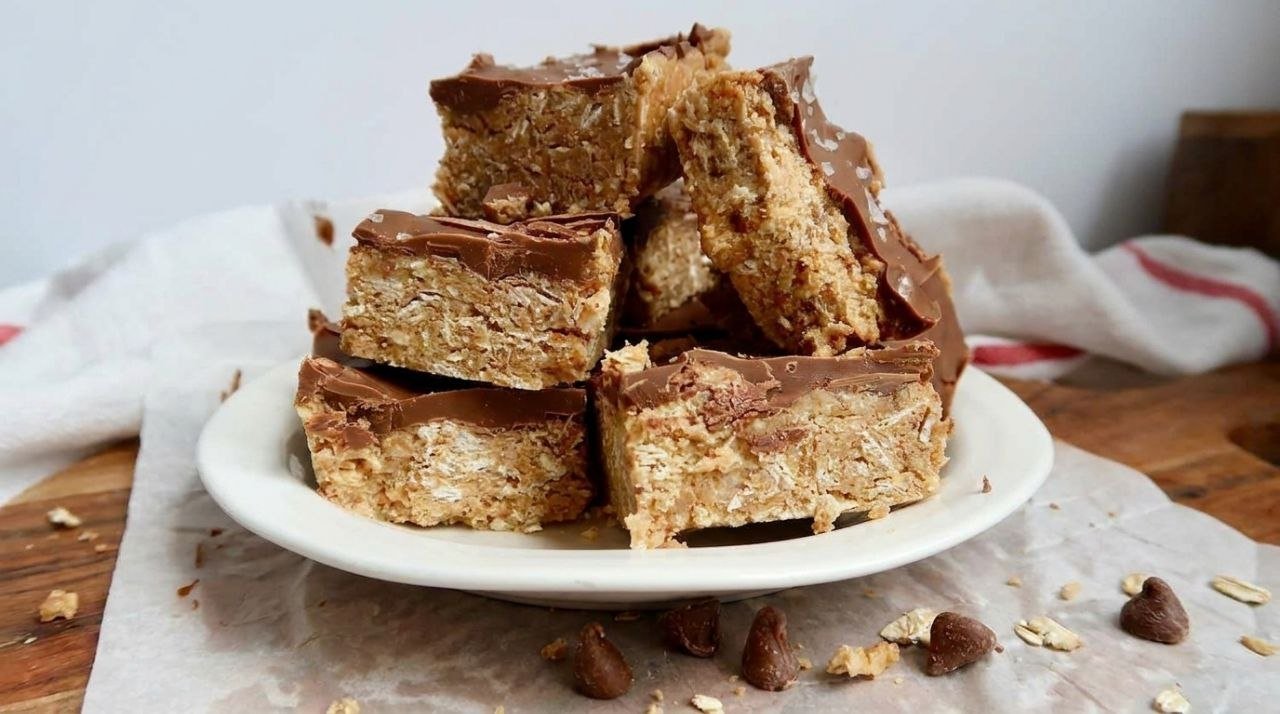
These no bake chocolate peanut butter oat bars use five pantry ingredients, require zero oven time, and produce a bar with three genuinely distinct layers — a dense, chewy peanut butter oat base, a thick layer of smooth chocolate in the middle, and a firmer chocolate top that sets in the freezer into something close to a chocolate shell. The whole assembly takes about fifteen minutes of hands-on work and two hours of refrigerator or freezer time to set completely. What you get at the end is a bar that tastes like a Reese’s peanut butter cup crossed with a granola bar — rich, chocolatey, and slightly sweet without ever tipping into the cloying territory that most store-bought bars land in.
The five-ingredient constraint is what makes this recipe so reproducible as a system. Every ingredient is available in any grocery store, none of them require special preparation, and the ratios are flexible enough that you can scale this recipe up or down without any changes to the method. Make a full 9×13 pan on a Sunday and cut it into twelve to sixteen bars that keep in the refrigerator all week — a ready-made answer to the daily “what do I eat for a snack” question that is faster to grab than almost anything else and more satisfying than almost all of it.
Why These Five Ingredients Produce Something This Good
Most five-ingredient recipes produce five-ingredient results — simple, acceptable, and flat. This recipe produces something that tastes layered and complex because each ingredient handles multiple roles simultaneously. The rolled oats provide structure, chew, and fiber. The peanut butter acts as binder, fat, flavor base, and sweetener all at once. The honey or maple syrup provides sweetness and acts as the adhesive that holds the oat and peanut butter mixture together into sliceable bars rather than crumbly loose granola. The coconut oil in the chocolate layer keeps the chocolate pourable at room temperature and helps it set firm and snappy when cold rather than staying soft and greasy. The chocolate itself — dark, milk, or chips — provides the flavor counterpoint that makes peanut butter taste even better than it does alone. Nothing in this recipe is decorative and nothing is redundant, which is why a five-ingredient bar tastes like it contains twice that many.
The Fat Chemistry Behind the Perfect Set
The texture of these bars after refrigerating or freezing depends almost entirely on how the fats in both layers behave at cold temperatures. Peanut butter contains a mix of saturated and unsaturated fats — the saturated component solidifies when cold, which is what turns the soft, spreadable base mixture into a firm, sliceable layer after time in the refrigerator. The more saturated fat in your peanut butter, the firmer the bar will set: natural peanut butter with a high oil content produces a softer bar, while conventional processed peanut butter with added hydrogenated oils sets harder and is easier to cut into clean pieces.
The chocolate top layer sets through a different but related mechanism. Cocoa butter — the natural fat in chocolate — has a melting point just below body temperature, which is why chocolate melts in your mouth. When you add coconut oil to melted chocolate, you are diluting the cocoa butter with a fat that has an even cleaner, sharper melting point, which produces a chocolate layer that sets harder and snaps more cleanly when bitten than pure chocolate alone would. This is the same technique used by candy makers for chocolate dipping and coating — a small percentage of coconut oil transforms melted chocolate from a soft, slightly tacky coating into a firm, glossy shell that holds its shape at refrigerator temperature and delivers that satisfying snap with every bite.
What Goes In
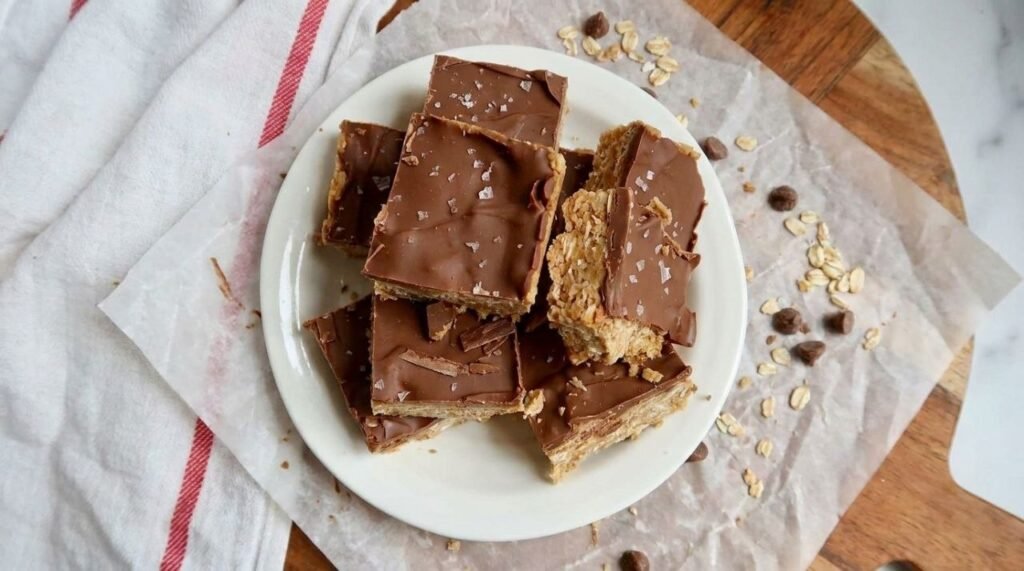
Five ingredients that you almost certainly already have in the pantry.
3 cups rolled oats (old-fashioned, not quick oats)
1 cup creamy peanut butter
1/3 cup honey or pure maple syrup
1.5 cups chocolate chips (dark, semi-sweet, or milk)
2 tablespoons coconut oil
Want to Build On It?
Add a teaspoon of vanilla extract and a pinch of salt to the peanut butter and honey mixture before combining with the oats — both are technically outside the five-ingredient list but cost nothing in terms of effort and dramatically improve the depth and balance of the base layer flavor.
Press a thin layer of additional peanut butter between the oat base and the chocolate top for an extra filling that makes the bar taste even closer to a Reese’s cup — this third layer adds about two minutes of work and makes a significant difference in the eating experience.
Sprinkle flaky sea salt over the melted chocolate immediately before refrigerating — the salt crystals melt slightly into the surface as the chocolate sets and create a sweet-salty contrast in every bite that is one of the most reliable flavor improvements in all of no-bake dessert making.
Use almond butter or sunflower seed butter instead of peanut butter for an allergy-friendly version that follows exactly the same method and produces a bar with a slightly milder, nuttier base flavor.
How to Make No Bake Chocolate Peanut Butter Oat Bars
Step 1 – Prep the pan: Line a 9×9 inch square baking pan (or 9×13 for thinner bars) with parchment paper, leaving an overhang on two sides so you can lift the entire slab out cleanly after setting. The parchment overhang is not optional — without it, the bars adhere to the pan and are very difficult to remove without breaking. Lightly spray the parchment with nonstick spray if you want additional insurance against sticking.
Step 2 – Make the oat base: In a large microwave-safe bowl, combine the peanut butter and honey. Microwave for 30 to 45 seconds until the peanut butter is slightly looser and easy to stir, then mix until completely smooth and combined. Add the rolled oats to the bowl and stir until every oat is fully coated in the peanut butter mixture. The mixture will be thick and stiff — this is correct. Transfer it to the prepared pan and press firmly into a dense, even layer using the flat bottom of a measuring cup, working from the center toward the edges until the surface is completely level and compact.
Step 3 – Melt the chocolate: Combine the chocolate chips and coconut oil in a microwave-safe bowl. Microwave in 30-second bursts, stirring between each burst, until the chocolate is completely melted and the coconut oil is fully incorporated into a smooth, pourable mixture with no remaining solid pieces. This typically takes two to three 30-second intervals. Do not overheat — chocolate that gets too hot seizes into a grainy, stiff paste rather than a smooth liquid, and seized chocolate cannot be recovered by stirring.
Step 4 – Pour and spread the chocolate: Pour the melted chocolate mixture over the pressed oat base and spread it quickly and evenly with a spatula, working across the entire surface before the chocolate begins to cool and thicken. Tap the pan gently on the counter two or three times to help the chocolate settle into an even layer and release any air bubbles. If adding flaky salt, sprinkle it now while the chocolate surface is still completely liquid so it adheres as the chocolate sets.
Step 5 – Set and slice: Transfer the pan to the refrigerator for at least two hours, or the freezer for 45 minutes, until the chocolate top is completely firm and the oat base holds together when pressed. Lift the entire slab out of the pan using the parchment overhang and transfer to a cutting board. Use a sharp knife to slice into bars — wipe the blade clean between cuts for the cleanest edges. If the chocolate cracks or splinters when cutting, let the slab sit at room temperature for three to five minutes to take the chill off the top layer before slicing.
3 Mistakes That Ruin No Bake Bars
Using quick oats instead of rolled oats: Quick oats are pre-steamed and partially cooked during processing, which makes them softer and finer than old-fashioned rolled oats. In a no-bake bar, this translates to a base that compresses into a pasty, dense, almost gummy texture rather than the chewy, structured bite that rolled oats produce. Rolled oats retain enough integrity after being pressed and refrigerated to give the base a proper chew that distinguishes a bar from a ball of sweetened oat paste.
Skipping the parchment lining: The combination of honey, peanut butter, and set chocolate creates an adhesive bond with the pan surface that is extremely difficult to break cleanly after the bars have set cold. Attempting to remove bars from an unlined pan results in broken slabs, crumbled bases, and a pan that requires significant soaking to clean. The parchment takes thirty seconds to cut and place and saves the entire batch from becoming a collection of irregular, broken pieces rather than clean, presentable bars.
Slicing straight from the freezer without resting: Chocolate set at freezer temperature is extremely brittle — significantly more so than chocolate set in the refrigerator — and a knife pressed through a frozen chocolate layer will almost always crack and shatter it rather than cutting cleanly. Allowing the slab to rest at room temperature for three to five minutes after removing from the freezer lets the chocolate transition from brittle-cold to firm-but-flexible, at which point a sharp knife slides through with minimal pressure and leaves clean, uncracked edges on both cut faces.
What to Serve with Chocolate Peanut Butter Oat Bars
These bars are self-contained and complete on their own, which makes them more of a standalone snack or dessert than something that needs a pairing. That said, they work particularly well as the “make-ahead” component of a larger no-bake dessert spread alongside our Strawberry Crunch Cheesecake Cups — the bright, fruity strawberry cups provide the visual and flavor contrast to the dense, chocolatey bars and together they cover both the fruit dessert and the chocolate dessert categories without any overlap. If you are building a healthy snack table rather than a full dessert spread, these bars sit naturally alongside our 3-Ingredient Banana Oat Cookies as a “clean, simple, naturally sweetened” theme that works for any time of day, any group, and any occasion that calls for food that is easy to make and easier to eat.

Easy No Bake Chocolate Peanut Butter Oat Bars
Ingredients
Equipment
Method
- How to Make No Bake Chocolate Peanut Butter Oat Bars
- Step 1 – Prep the pan: Line a 9×9 inch square baking pan (or 9×13 for thinner bars) with parchment paper, leaving an overhang on two sides so you can lift the entire slab out cleanly after setting. The parchment overhang is not optional — without it, the bars adhere to the pan and are very difficult to remove without breaking. Lightly spray the parchment with nonstick spray if you want additional insurance against sticking.
- Step 2 – Make the oat base: In a large microwave-safe bowl, combine the peanut butter and honey. Microwave for 30 to 45 seconds until the peanut butter is slightly looser and easy to stir, then mix until completely smooth and combined. Add the rolled oats to the bowl and stir until every oat is fully coated in the peanut butter mixture. The mixture will be thick and stiff — this is correct. Transfer it to the prepared pan and press firmly into a dense, even layer using the flat bottom of a measuring cup, working from the center toward the edges until the surface is completely level and compact.
- Step 3 – Melt the chocolate: Combine the chocolate chips and coconut oil in a microwave-safe bowl. Microwave in 30-second bursts, stirring between each burst, until the chocolate is completely melted and the coconut oil is fully incorporated into a smooth, pourable mixture with no remaining solid pieces. This typically takes two to three 30-second intervals. Do not overheat — chocolate that gets too hot seizes into a grainy, stiff paste rather than a smooth liquid, and seized chocolate cannot be recovered by stirring.
- Step 4 – Pour and spread the chocolate: Pour the melted chocolate mixture over the pressed oat base and spread it quickly and evenly with a spatula, working across the entire surface before the chocolate begins to cool and thicken. Tap the pan gently on the counter two or three times to help the chocolate settle into an even layer and release any air bubbles. If adding flaky salt, sprinkle it now while the chocolate surface is still completely liquid so it adheres as the chocolate sets.
- Step 5 – Set and slice: Transfer the pan to the refrigerator for at least two hours, or the freezer for 45 minutes, until the chocolate top is completely firm and the oat base holds together when pressed. Lift the entire slab out of the pan using the parchment overhang and transfer to a cutting board. Use a sharp knife to slice into bars — wipe the blade clean between cuts for the cleanest edges. If the chocolate cracks or splinters when cutting, let the slab sit at room temperature for three to five minutes to take the chill off the top layer before slicing.
Notes
