
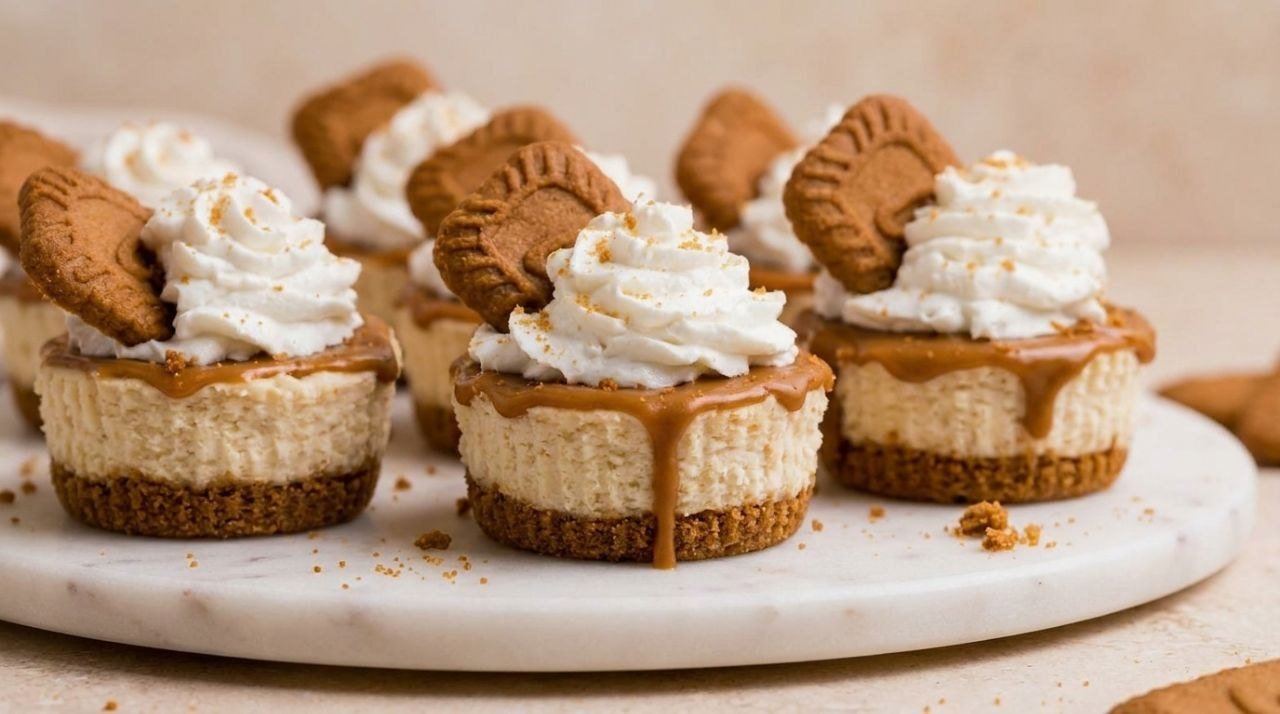
Four ingredients, no oven, no water bath, no springform pan — these Biscoff cheesecake bites deliver everything you love about a classic cheesecake in a format that is bite-sized, shareable, and ready after a few hours in the freezer rather than an entire day of planning. The base is a pressed Biscoff cookie crumb that stays firm and snappy even after freezing. The filling is a thick, cold-set mixture of cream cheese and Biscoff spread that tastes like the inside of a luxury cheesecake but comes together in under five minutes. A thin drizzle of melted Biscoff on top sets into a crackly, caramelized layer that gives each bite a satisfying snap before the smooth, creamy center. These are the kind of dessert that disappear from a plate in minutes and always prompt people to ask what is in them.
What makes this recipe work beyond its simplicity is that Biscoff does most of the flavor work on its own. The spread brings warmth from cinnamon and other baking spices, a deep caramelized sweetness from the cookie base it is made from, and a fat content high enough to set firmly when cold without needing gelatin or any stabilizer. You do not need to add sugar to the filling because the spread is already sweet, you do not need to add flavor because the spice is already there, and you do not need to add texture because the cookie crumb base handles that entirely. The result is a four-ingredient dessert that tastes like it contains far more than four ingredients.
Why Four Ingredients Are Enough
Most cheesecake recipes require a long ingredient list because the flavor, the texture, the sweetness, and the stability all need to be built separately from neutral components. Biscoff cheesecake bites are different because the Biscoff spread is not a neutral ingredient — it is already a fully developed flavor system in a jar. It provides the sweetness, the spice, the fat for setting, and the caramel-forward taste profile all at once, which means every other ingredient in the recipe only needs to handle one job. The cream cheese provides structure and tang. The Biscoff cookies provide the base. The melted spread on top provides the finish. There is no redundancy and no gap, which is why the recipe does not feel incomplete despite its brevity.
The Fat Science Behind a No-Bake Set
Understanding why these bites set firmly without gelatin, eggs, or a hot oven starts with the fat composition of the two main ingredients. Cream cheese is roughly 34% fat by weight, primarily in the form of saturated and monounsaturated fatty acids that are solid at refrigerator temperature and liquid at room temperature. Biscoff spread has a similar fat profile derived from the palm oil and cookie fat in its base. When these two high-fat ingredients are combined and chilled, the fats crystallize and lock the mixture into a firm, sliceable mass through a process called lipid solidification — the same principle that makes butter solid in the fridge and liquid on a warm counter. No structural additive is needed because the fat itself provides all the rigidity required, as long as the bites stay cold from the freezer or refrigerator until the moment they are eaten.
The Biscoff cookie base behaves differently from a standard graham cracker crumb because Lotus Biscoff cookies have a lower moisture content and a higher sugar density than most other cookies used in no-bake bases. When crushed and pressed, they form a base that stays significantly crisper for longer than graham crackers, even after extended contact with the moist cream cheese filling above. This is partly due to the caramelization that happens during the baking of the cookies themselves — the high sugar content has already been transformed into a glass-like amorphous solid that resists moisture absorption far better than a less heavily caramelized crumb. The result is a base that stays snappy and defined even after several hours in the freezer, which is one of the small details that makes these bites feel polished rather than homemade.
What Goes In

Four ingredients, nothing else needed.
20 Lotus Biscoff cookies, for the base
3 tablespoons unsalted butter, melted
8 oz full-fat cream cheese, softened to room temperature
1/2 cup Biscoff spread, plus extra for drizzling on top
Want to Take It Further?
Add 1/2 teaspoon of pure vanilla extract to the filling for a subtle background note that rounds out the spice in the Biscoff spread without competing with it.
Fold 1/4 cup of lightly whipped heavy cream into the filling before portioning for a slightly lighter, airier texture that melts more gently on the palate.
Press a whole Biscoff cookie vertically into each bite before the drizzle sets for a dramatic presentation that immediately communicates the flavor to anyone looking at the plate.
Sprinkle a small pinch of flaky sea salt over the Biscoff drizzle before it sets to add a sharp contrast that cuts through the sweetness and makes each bite taste more complex.
How to Make Biscoff Cheesecake Bites
Step 1 – Make the cookie base: Crush the Biscoff cookies in a zip-lock bag with a rolling pin until you have fine, even crumbs with very few large chunks remaining. Transfer to a bowl and add the melted butter, then mix until all the crumbs are evenly moistened and the mixture holds together when pressed between your fingers. The base does not need to be baked — the butter binds the crumbs immediately and the freezer will do the rest of the work.
Step 2 – Press the base into the cups: Line a mini muffin tin with paper liners or use a silicone mini muffin mold. Spoon about one heaping teaspoon of the crumb mixture into each cup and press firmly with the back of a small spoon or your fingertip to create a compact, even base layer. Place the tin in the freezer for 10 minutes while you prepare the filling so the base firms up before the filling goes on top.
Step 3 – Make the filling: Microwave the Biscoff spread for 15 seconds until fluid and smooth. In a bowl, beat the softened cream cheese with a hand mixer for one minute until completely smooth and lump-free. Add the warmed Biscoff spread and beat on medium speed for another minute until the mixture is uniform in color, completely combined, and holds a thick, spoonable consistency. Do not overmix once the spread is incorporated — the filling thickens as it cools and overmixing at this stage can make it grainy.
Step 4 – Fill and freeze: Remove the base tin from the freezer. Spoon or pipe the Biscoff cream cheese filling over each base, filling each cup to just below the rim and smoothing the top lightly with the back of a spoon. Transfer the tin back to the freezer and chill for a minimum of 2 hours, or until the filling is firm and set completely through to the center when pressed gently.
Step 5 – Drizzle and serve: Remove the bites from the freezer 5 minutes before serving. Microwave a few additional tablespoons of Biscoff spread for 10 to 15 seconds until very fluid, then drizzle over the top of each bite using a spoon or a small piping bag. The warm spread will set quickly on the cold surface of the filling, forming a thin, glossy, slightly crackly layer within a minute or two. Serve immediately or return to the freezer for up to two weeks in an airtight container.
3 Mistakes That Ruin Cheesecake Bites
Using cold cream cheese straight from the fridge: Cold cream cheese does not blend smoothly regardless of how long you mix it. It breaks into small, grainy chunks that stay suspended in the filling and create an uneven texture that is immediately noticeable in every bite. The cream cheese needs to sit at room temperature for at least 45 minutes before mixing — it should be soft enough to press a fingerprint into easily and yield to a spoon without resistance.
Not pressing the base firmly enough: A loosely packed crumb base crumbles the moment you try to remove the bites from the mold or take a bite. The key is to press with real pressure — use the bottom of a small shot glass or a measuring spoon to compress the crumbs into a dense, flat disc that holds together as a single unit. If the base crumbles when you press it with your finger before freezing, add another half teaspoon of melted butter and re-press.
Drizzling with spread that is too hot: Biscoff spread that has been overheated becomes very thin and watery, and it will run off the sides of the bites rather than sitting on top in a controlled drizzle. It also melts the surface of the cold filling underneath rather than setting on top of it. Heat the spread in short 10-second intervals until it is just fluid enough to drizzle — it should fall in a slow, ribbon-like stream from the spoon, not pour freely like water.
What to Serve with Biscoff Cheesecake Bites
These bites are rich, cold, and intensely flavored, which makes them best served in small portions alongside something that provides contrast or a palate reset between pieces. A strong black coffee or an espresso is the most natural pairing — the bitterness cuts directly through the sweetness of the Biscoff and makes each bite taste fresher than the last. On a dessert table, they sit beautifully next to our Strawberry Shortcake Cups, where the cold, fruit-forward brightness of the shortcake cups provides a direct contrast to the warm spice and caramel depth of the Biscoff bites and gives guests two very different dessert experiences in the same format. If you are building a platter of sweets for a gathering, add our Easy Lemon Bars to the spread — the sharp citrus cuts through the richness of the cheesecake bites and keeps the table balanced rather than overwhelmingly sweet from end to end.

Easy No Bake Biscoff Cheesecake Bites
Ingredients
Equipment
Method
- How to Make Biscoff Cheesecake Bites
- Step 1 – Make the cookie base: Crush the Biscoff cookies in a zip-lock bag with a rolling pin until you have fine, even crumbs with very few large chunks remaining. Transfer to a bowl and add the melted butter, then mix until all the crumbs are evenly moistened and the mixture holds together when pressed between your fingers. The base does not need to be baked — the butter binds the crumbs immediately and the freezer will do the rest of the work.
- Step 2 – Press the base into the cups: Line a mini muffin tin with paper liners or use a silicone mini muffin mold. Spoon about one heaping teaspoon of the crumb mixture into each cup and press firmly with the back of a small spoon or your fingertip to create a compact, even base layer. Place the tin in the freezer for 10 minutes while you prepare the filling so the base firms up before the filling goes on top.
- Step 3 – Make the filling: Microwave the Biscoff spread for 15 seconds until fluid and smooth. In a bowl, beat the softened cream cheese with a hand mixer for one minute until completely smooth and lump-free. Add the warmed Biscoff spread and beat on medium speed for another minute until the mixture is uniform in color, completely combined, and holds a thick, spoonable consistency. Do not overmix once the spread is incorporated — the filling thickens as it cools and overmixing at this stage can make it grainy.
- Step 4 – Fill and freeze: Remove the base tin from the freezer. Spoon or pipe the Biscoff cream cheese filling over each base, filling each cup to just below the rim and smoothing the top lightly with the back of a spoon. Transfer the tin back to the freezer and chill for a minimum of 2 hours, or until the filling is firm and set completely through to the center when pressed gently.
- Step 5 – Drizzle and serve: Remove the bites from the freezer 5 minutes before serving. Microwave a few additional tablespoons of Biscoff spread for 10 to 15 seconds until very fluid, then drizzle over the top of each bite using a spoon or a small piping bag. The warm spread will set quickly on the cold surface of the filling, forming a thin, glossy, slightly crackly layer within a minute or two. Serve immediately or return to the freezer for up to two weeks in an airtight container.
Notes
