
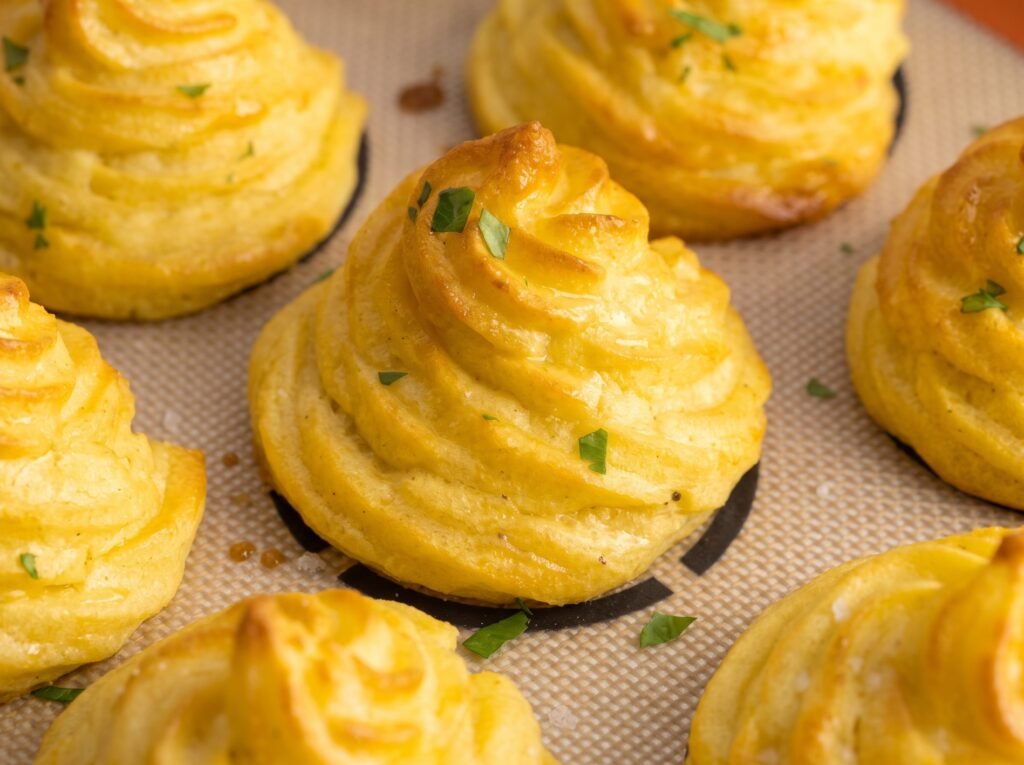
Every holiday table needs one side dish that makes people lean in and ask how you did it. For me that dish is duchess potatoes. They are simply mashed potatoes, enriched with butter and egg yolk, piped through a star tip into little swirls and baked until the ridges turn deep golden and crunchy while the middle stays soft and creamy.
The part I love most is how forgiving the whole thing is. If you can boil a potato and squeeze a piping bag, you can make these. The egg yolk gives the mash enough structure to hold its shape in the oven, and the high heat does the rest. You get the comfort of mashed potatoes with the crisp edges of a roast potato in the same bite.
I make them most often for Christmas and New Year, because they can be piped well ahead and baked at the last minute, which frees up the stove and the nerves. This guide covers the right potato to use, how to get a mash that pipes cleanly, how to freeze the rosettes and what to do if they slump.
What Makes Duchess Potatoes Different
A regular mashed potato is meant to be soft and loose. Duchess potatoes are meant to be firm enough to stand up in a swirl and survive a hot oven. That difference comes down to three things: a dry mash, an egg yolk and a gentle hand when mixing.
Starchy potatoes break down into a fluffy, absorbent mash. Once they are drained and left to steam dry, they hold far less water than ordinary mashed potatoes, which is why the piped shapes keep their ridges. The yolk adds richness and binds everything, then sets in the oven so each rosette develops a thin, golden shell.
The result sits somewhere between a mashed potato and a croquette. It is soft inside, crisp outside and rich enough that it needs no gravy, although it never turns one down.
Ingredients and Why They Matter
- Russet or Yukon Gold potatoes (2 1/2 pounds): russets make the fluffiest, driest mash, while Yukon Golds give a buttery flavor and slightly denser swirl. Either works well.
- Unsalted butter (4 tablespoons): gives flavor and a silky texture. Melted butter blends in more evenly.
- Egg yolks (2 large): the structure and the golden color. Do not substitute whole eggs, because the whites make the mash too wet.
- Heavy cream (1/4 cup): just enough to loosen the mash without making it soft. Warm it first.
- Fine salt, white pepper and fresh nutmeg: nutmeg is the classic seasoning and a small pinch lifts the whole dish.
- One beaten egg yolk with a teaspoon of water: brushed over the top for a glossy, deeply golden finish.
Step-by-Step Method
Boil and dry the potatoes
Peel the potatoes and cut them into even 1 1/2 inch (4 cm) chunks. Place them in a large pot, cover with cold salted water by an inch and bring to a boil. Reduce to a steady simmer and cook for 15 to 20 minutes, until a knife slides in with no resistance.
Drain well, then return the potatoes to the empty hot pot over low heat for 1 to 2 minutes, shaking gently. You should see steam rise and a thin film form on the bottom. This step removes surface moisture and is the single biggest factor in a pipeable mash.
Mash and enrich
Pass the potatoes through a ricer or food mill for the smoothest texture. A hand masher works too, as long as you mash until absolutely no lumps remain, because lumps will clog the piping tip. Stir in the melted butter, warm cream, egg yolks, salt, pepper and nutmeg until just combined. Do not beat the mash vigorously or it can turn gluey.
Pipe and bake
Heat the oven to 425F (220C) and line two baking sheets with parchment. Spoon the warm mash into a piping bag fitted with a large open star tip, about 1/2 inch wide. Pipe rosettes about 2 inches (5 cm) wide and 1 1/2 inches tall, spacing them an inch apart.
Brush the rosettes lightly with the yolk wash. Bake for 22 to 28 minutes, rotating the pans halfway, until the ridges are deep golden brown and the bases are set. Serve straight away.
- Boil peeled, chunked potatoes until completely tender and drain very well.
- Steam the potatoes dry in the hot pot, then rice them until smooth.
- Stir in butter, cream, yolks and seasonings.
- Pipe rosettes onto parchment with a large star tip.
- Brush with yolk wash and bake at 425F until golden.
Tips for Perfect Rosettes
- Pipe while the mash is warm. Cold mash stiffens and becomes hard to squeeze, which can split the bag.
- Use a large star tip. A small tip creates fragile ridges that burn before the center sets. Aim for a 1/2 inch opening.
- Fill the bag only halfway. A full bag is hard to control and pushes mash out of the top.
- Chill the piped shapes for 20 minutes. Firm rosettes bake with sharper edges and less spread.
- Use parchment, not foil. The potatoes release cleanly and brown evenly on the bottom.
Make Ahead and Freezing
This is the reason duchess potatoes belong on every holiday menu. You can pipe the rosettes up to 24 hours ahead, cover the sheet loosely with plastic wrap and refrigerate. Brush with the yolk wash just before they go into the oven, and add 3 to 5 minutes of baking time because they start cold.
For longer storage, freeze the piped, unbaked rosettes on the parchment-lined sheet until solid, about 2 hours. Move them to a freezer bag, where they keep for up to 2 months. Bake straight from frozen at 425F for 30 to 35 minutes, no thawing needed. Thawing first makes them soften and lose their ridges.
Pairing is easy. They sit beautifully beside a prime rib roast, next to herb crusted beef tenderloin or alongside honey glazed ham, and they make a lovely partner for crisp yorkshire puddings on a roast dinner plate.
Variations to Try
- Parmesan and chive: fold 1/3 cup finely grated parmesan and 2 tablespoons chopped chives into the mash.
- Roasted garlic: squeeze in 4 cloves of roasted garlic for a mellow, sweet flavor, similar to roasted garlic mashed potatoes.
- Sweet potato swap: replace half the potatoes with baked sweet potato, but keep the mash dry and add an extra yolk.
- Gruyere nests: pipe a ring, add a pinch of grated gruyere in the center and bake for a molten middle.
- Herb crust: sprinkle finely chopped thyme and breadcrumbs on top after the yolk wash for extra crunch.
- One big dish: pipe the mash in overlapping swirls over a baking dish to make a topping for a shepherd’s pie.
Troubleshooting
| Problem | Likely cause and fix |
|---|---|
| Rosettes spread and lose shape | The mash was too wet. Steam the potatoes dry longer next time and chill the piped shapes before baking. |
| Mash is gluey | Overmixing or using a blender. Use a ricer and stir gently. |
| Edges brown but centers are cold | Rosettes are too tall. Pipe them lower or bake 5 more minutes. |
| Tip clogs or bag splits | Lumps in the mash or mash that is too cold. Rice the potatoes and pipe while warm. |
| No color on top | Skipped the yolk wash or the oven is too cool. Use a thermometer to check 425F. |
Storage and Food Safety
Baked duchess potatoes are best the moment they come out of the oven, but leftovers keep in an airtight container in the refrigerator for up to 3 days. Rewarm them on a baking sheet at 400F for 10 to 12 minutes so the ridges crisp up again. The microwave makes them soft, so avoid it if you can.
Cooked potatoes should not sit out at room temperature for more than 2 hours, so refrigerate leftovers promptly. The USDA offers clear guidance in its leftovers and food safety guide, including how to reheat food safely. Because the yolks are baked into the mash at a high oven temperature, the finished rosettes are fully cooked.
Frequently Asked Questions
What are duchess potatoes?
Duchess potatoes are mashed potatoes enriched with butter and egg yolk, then piped into decorative swirls and baked until golden. The edges are crisp and the centers remain soft and creamy.
Can I make duchess potatoes without a piping bag?
Yes. Scoop the mash into mounds with a large cookie scoop or two spoons, then rough up the tops with a fork. You will not get tidy ridges, but the peaks crisp nicely. A zip-top bag with a corner cut off also works as a stand-in, although a star tip gives the classic look.
Why did my duchess potatoes turn out flat?
Flat rosettes almost always mean the mash held too much water or cream. Boil the potatoes in large chunks, steam them dry in the hot pot, and use only the cream in the recipe. Chilling the piped shapes before baking also helps them hold their lines.
Can I freeze duchess potatoes before baking?
Yes, and it is the best way to prepare them in advance. Freeze the piped rosettes on a lined baking sheet until solid, store them in a freezer bag for up to 2 months and bake them straight from frozen with a little extra time.
What can I serve with duchess potatoes?
They suit any roast or braise, such as prime rib, beef tenderloin, roast chicken or glazed ham. Add a green vegetable like garlic parmesan green beans and a spoonful of gravy for a complete holiday plate.
If you make these golden rosettes, please leave a star rating and tell me in the comments how your piping went. For more holiday dishes to build a full menu around them, browse all of my side dish recipes.

Duchess Potatoes
Ingredients
Equipment
Method
- Place the potatoes in a large pot, cover with cold salted water and bring to a boil. Simmer 15 to 20 minutes until completely tender.
- Drain well and return the potatoes to the hot empty pot over low heat for 1 to 2 minutes to steam dry.
- Pass the potatoes through a ricer into a bowl. Stir in the butter, cream, 2 yolks, salt, pepper and nutmeg until just combined and smooth.
- Heat the oven to 425F (220C) and line two baking sheets with parchment.
- Spoon the warm mash into a piping bag fitted with a large star tip and pipe 2 inch rosettes, 1 inch apart.
- Whisk the remaining yolk with the water and brush lightly over the rosettes.
- Bake 22 to 28 minutes, rotating the pans halfway, until the ridges are deep golden. Serve warm.
Notes
Duchess potatoes prove that a few small steps, a dry mash, a yolk and a star tip, can turn a humble potato into the dish everyone remembers. Pipe them ahead, tuck them in the freezer and let the oven do the showing off on the big day. Happy cooking, friends. Chef Amber
Free email bonus
30-Minute Meals
Loved this recipe? Get my collection of fast, family-favorite dinners, plus new seasonal recipes straight to your inbox.